
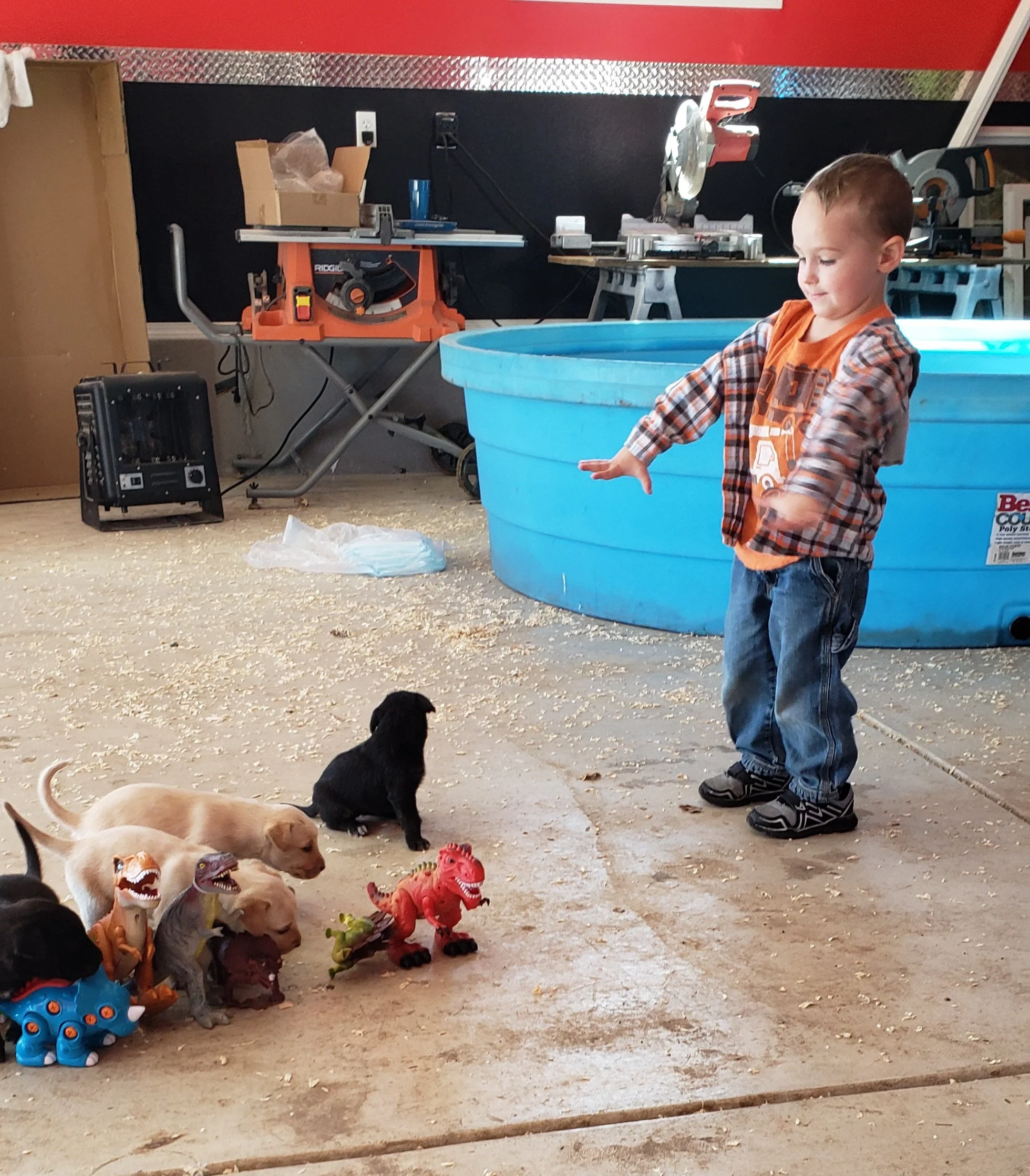
Trust Is Built Through Communication
One of the core beliefs of our program is that puppies deserve a voice.
That does not mean puppies get to make every decision. It means we pay attention to what they are communicating.
Every puppy is constantly giving us information.
They tell us when they are confident.
They tell us when they are uncertain.
They tell us when they are frustrated.
They tell us when they are ready for more challenge and when they need additional support.
The way we respond to those moments helps shape the relationship they develop with people.
When a puppy learns that its communication matters, trust begins to grow.
That trust becomes incredibly important later when we introduce new experiences, challenges, and environments.
A puppy that trusts the people guiding them is often willing to try things that initially feel uncomfortable or unfamiliar because they have learned that we listen, we pay attention, and we help them succeed.
This does not mean we remove every challenge.
In many cases, confidence is built by working through a challenge rather than avoiding it.
Our role is to help puppies find the balance between support and independence so they can discover what they are capable of.
Raised In Our Home — What That Really Means
Many breeders advertise that their puppies are raised in their home.
So do we.
But we believe the phrase is often given more credit than it deserves.
Being raised in a home does not automatically prepare a puppy for life with a family.
A puppy can be raised in a home and still have very few meaningful experiences.
A puppy can be raised in a home and spend most of its time tucked away in a separate room.
A puppy can be raised in a home and never learn how to navigate challenges, recover from frustration, or adapt to change.
What matters is not simply the address.
What matters is what happens during those weeks.
Our puppies are raised as part of our daily lives. They experience normal household activity, different spaces, new environments, changing routines, visitors, sounds, surfaces, movement, and age-appropriate challenges.
They may spend time in our home, yard, shop, barn, work office, grooming spaces, outdoor areas, and other real-life environments.
The goal is not simply exposure.
The goal is preparation.
Every experience is an opportunity to build confidence, resilience, trust, and adaptability that will continue serving the puppy long after they leave our home and join yours.
Raised In Our Home — What That Really Means - see Our Process
Built On Proven Programs, Refined Through Experience
Families often ask which puppy curriculum we follow.
The answer is not a simple one.
Over the years, we have studied and incorporated concepts from many respected puppy development programs, including Puppy Culture, Badass Breeder, Early Neurological Stimulation, Early Scent Introduction, and other established approaches to puppy development.
These programs have contributed tremendously to our understanding of how puppies learn, recover, adapt, and engage with the world around them.
But no curriculum can replace observation.
No checklist can replace experience.
And no calendar can tell us more than the puppies themselves.
The frameworks we use provide a roadmap. They help us understand what experiences may be beneficial and when those experiences are often introduced.
What they cannot do is evaluate the individual puppies standing in front of us.
That is our job.
Some litters develop exactly as expected.
Others progress more quickly.
Others benefit from a slower pace.
Sometimes we look at a litter and realize they are developmentally several days behind where the calendar suggests they should be. In those situations, we adjust.
That may mean introducing experiences later.
It may mean simplifying an exercise.
It may mean slowing down.
It may mean moving forward sooner because the puppies are showing us they are ready.
The goal is never to complete a curriculum exactly on schedule.
The goal is to support healthy development in the puppies we have, not the puppies we expected to have.
Every decision comes back to the same question:
What are the puppies telling us they need right now?
We Raise Individual Puppies, Not Just Litters
Developmental programs provide valuable structure, but puppies do not develop according to a perfectly predictable schedule.
The calendar provides a rough outline.
The puppies tell us how to use it.
A litter may be five weeks old on paper, but that does not mean every puppy in that litter is at the exact same developmental place.
One puppy may be ready for a bigger challenge.
Another may need the challenge simplified.
One may confidently explore a new object.
Another may need extra time, patience, or support.
Part of giving puppies a voice means recognizing those differences.
We are not simply raising litters.
We are raising individual puppies within each litter.
This is also why temperament testing is approached thoughtfully. If a litter is not developmentally ready, we may delay testing. If the results do not match what we are consistently seeing in real life, we look closer.
The goal is not to force puppies through a process.
The goal is to understand who they are becoming.
Building Confidence Through Empowerment
Confidence is not built by removing every challenge.
It is built by helping puppies discover that they can work through challenges successfully.
This is where empowerment matters.
A simple example is learning the dog door.
Some puppies figure it out quickly.
Some hesitate.
Some whine.
Some stand there convinced the entire situation is unfair.
We do not immediately rescue them from the challenge. We give them space to think, explore, try, and problem-solve.
If a puppy truly needs support, we adjust. Sometimes that means making the challenge easier. Sometimes that means showing the puppy part of the process so they can discover they are capable of completing it.
The goal is not to let puppies struggle endlessly.
The goal is also not to remove the challenge the moment they become uncomfortable.
The goal is to help them succeed.
A puppy may begin an experience unsure, frustrated, or hesitant and come out of that same experience more confident because they discovered they could do it.
That lesson matters.
Over time, these moments teach puppies:
I can try.
I can recover.
I can do hard things.
That mindset becomes part of the foundation they carry into future experiences.
We Are Raising More Than Behaviors
When people think about puppy development, they often focus on behavior.
Is the puppy confident?
Is the puppy social?
Is the puppy calm?
Is the puppy resilient?
Those things matter.
But underneath every behavior is a nervous system.
One of our primary goals during puppyhood is helping puppies develop the ability to experience something new, recover from it, and learn that they are safe.
This process is repeated hundreds of times throughout puppyhood.
A puppy encounters a new sound.
A new surface.
A new environment.
A new challenge.
A new person.
A new experience.
Sometimes the puppy moves forward confidently.
Sometimes the puppy hesitates.
Sometimes the puppy startles.
Sometimes the puppy needs encouragement.
Sometimes the puppy needs rest.
What matters most is not whether the puppy experiences stress.
What matters is whether the puppy learns how to recover from it.
Confidence is not the absence of uncertainty.
Resilience is not the absence of stress.
Both are built through experiencing something new, processing it, recovering from it, and discovering that everything is okay.
Those recovery skills become part of the foundation that helps puppies grow into stable, adaptable adult dogs.
Sound, Rest, and Nervous System Recovery
Puppies are learning even during the quieter parts of the day.
The sounds they hear, the routines they experience, and the environments they rest in all matter.
Our puppies are exposed to a variety of household sounds, outdoor sounds, voices, movement, activity, and everyday background noise.
We also intentionally use calming auditory enrichment as part of their environment.
Puppies often listen to classical music, including Mozart, for part of the afternoon. The purpose is not to make puppies smarter. The purpose is to create a calm, predictable sound environment that supports rest, relaxation, and positive associations.
At night, we use pink noise throughout our home for puppies, adult dogs, and people. Pink noise provides a consistent background sound that helps soften sudden noises and creates a more predictable resting environment.
Rest matters.
Recovery matters.
Puppies do not only need exposure. They also need time for their nervous systems to process what they have experienced.
A puppy may enter a new space feeling unsure.
They may protest.
They may explore.
They may settle.
They may fall asleep.
By the time they wake up, that same space may feel completely normal.
From the puppy’s perspective, the lesson becomes:
I was uncomfortable.
Nothing bad happened.
I recovered.
I can handle this.
That is development.
Real-World Experiences Every Day
Our goal is for puppies to experience something new every day.
Not overwhelming.
Not random.
Not careless.
Purposeful.
New things happen in life. The world is unpredictable. Sounds happen. People move. Surfaces change. Weather changes. Doors open. Cars pass. Children laugh. Dogs bark. Life does not stay perfectly controlled.
We want puppies to learn that new things are normal.
They may experience:
Household activity
Visitors
Children
Adult dogs
Grooming tools
Nail trims
Brushing
New toys
New surfaces
Outdoor spaces
Water play
Crates
Dog doors
Car rides
The barn
The shop
The yard
The office
New sounds
New challenges
Different handling experiences
But the goal is not simply checking items off a list.
The goal is helping puppies learn how to process new experiences and recover from them.
Learning how to recover from new experiences is part of what helps puppies grow into sound, stable, adaptable dogs throughout life.
We cannot expose puppies to everything they will ever experience.
That would be impossible.
What we can do is help them develop the confidence, trust, and resilience needed to handle the experiences that are still ahead.
What This Looks Like In Real Life
While philosophy guides our decisions, puppy development ultimately happens through real-world experiences.
Throughout puppyhood, our curriculum may include:
Early Neurological Stimulation
Gentle, age-appropriate exercises used during early development to introduce mild stressors in a controlled way.
The goal is not to overwhelm puppies.
The goal is to support early neurological development and recovery.
Early Scent Introduction
Puppies are introduced to different scents during early development.
This supports curiosity, sensory development, and early engagement with the world around them.
Handling and Grooming Preparation
Handling begins long before a puppy ever receives its first nail trim or grooming appointment.
It begins with trust.
During the first few days of life, our interactions are intentionally limited. Newborn puppies are weighed daily and monitored closely, but we avoid unnecessary handling while they adjust to life outside the womb.
Around day three, we begin Early Neurological Stimulation (ENS) and Early Scent Introduction (ESI). These exercises are brief, lasting only seconds, and are performed once daily. The goal is not extensive handling. The goal is introducing small, age-appropriate experiences while respecting the puppy's stage of development.
As puppies mature, handling becomes more intentional.
Around three weeks of age, we begin our handling exercises, which include ears, paws, toes, tails, mouths, bodies, and other areas puppies will encounter throughout life during grooming, veterinary care, and everyday interactions.
In the beginning, the focus is not restraint.
The focus is trust.
A gentle touch.
A brief interaction.
Positive experiences.
Affection.
Patience.
As puppies become comfortable, we gradually increase duration, expectations, and pressure in a way that allows confidence to develop without overwhelming the puppy.
The goal is not simply teaching puppies to tolerate handling.
The goal is teaching puppies that human touch is safe.
That foundation becomes incredibly important throughout the puppy's life.
Veterinary exams, grooming appointments, nail trims, brushing sessions, children touching ears and paws, and everyday care all become easier when a puppy has spent weeks learning to trust the people handling them.
That foundation is then expanded through regular grooming experiences throughout puppyhood.
Puppies receive weekly nail trims beginning early in development. While most puppies do not initially enjoy having their feet handled, regular nail care allows us to gradually build comfort, trust, and familiarity with the process.
Around four weeks of age, puppies begin receiving baths. These early grooming experiences help introduce water, drying, handling, and the routines they will encounter throughout their lives.
At approximately five to six weeks of age, puppies receive their first face, feet, and sanitary trim. This process is repeated again before going home.
The purpose is not creating a perfectly groomed puppy.
The purpose is creating a familiar experience.
For many puppies, their first professional grooming appointment can feel overwhelming if everything is completely new.
We would rather introduce those experiences gradually, in a familiar environment, with people the puppy already trusts.
Every nail trim.
Every bath.
Every brushing session.
Every grooming table experience.
Every face, feet, and fanny trim.
They all serve the same purpose:
Helping puppies learn that being handled, groomed, and cared for is a normal part of life.
Those small experiences add up over time and help create a puppy that is better prepared for the grooming, veterinary care, and everyday handling they will experience throughout adulthood.
Learn More About Goldendoodle Coat Types, Shedding & Grooming
Problem Solving and Confidence Activities
Confidence is not something we can give a puppy.
It is something the puppy discovers for themselves.
One of the ways we help build confidence is through age-appropriate problem-solving opportunities.
Throughout puppyhood, puppies encounter obstacles, tunnels, slides, different surfaces, toys, dog doors, barriers, and new environments designed to encourage exploration and independent thinking.
The goal is not simply completing the obstacle.
The goal is what the puppy learns while working through it.
A puppy that successfully pushes through a dog door learns something very different than a puppy that is simply carried through it.
A puppy that figures out how to navigate a new surface gains confidence that cannot be taught through reassurance alone.
Many of these experiences initially create uncertainty.
Puppies may hesitate.
They may become frustrated.
They may stop and think.
That is part of the process.
We do not immediately rescue puppies from every challenge.
Instead, we help them discover that they are capable of overcoming obstacles on their own.
If a puppy genuinely needs support, we adjust.
If they simply need time to think, we give them that opportunity.
The goal is not to overwhelm puppies.
The goal is to empower them.
Over time, these experiences help puppies develop an important mindset:
New things are not automatically scary.
Problems can be solved.
Frustration is temporary.
I can recover.
I can try again.
I can do hard things.
Those lessons become part of the foundation that helps puppies grow into confident, resilient adult dogs capable of adapting to the many new experiences they will encounter throughout life.
Sound Exposure
Life is noisy.
One of our goals during puppyhood is helping puppies learn that everyday sounds are simply part of life.
As puppies move through different areas of our home, we intentionally incorporate sounds that naturally occur in those environments.
In the kitchen, that may mean cupboards closing, pans being set down, dishes moving, or appliances running.
In the bathroom, it may include flushing toilets, shower curtains moving, cabinet doors opening and closing, or the sounds of a normal morning routine.
Throughout the day, puppies experience the sounds of children playing, doors opening and closing, people moving through the house, conversations, household activity, and the general unpredictability of everyday life.
We also intentionally introduce sounds puppies may encounter later but are unlikely to hear regularly in our home.
Using Alexa and other audio sources, puppies may hear fireworks, thunder, train horns, construction sounds, barking dogs, cats meowing, different styles of music, and other environmental sounds.
Some puppies eventually accompany us to work, where they may experience forklifts, air compressors, tools, equipment, construction activity, and the sounds of a busy workplace.
Puppy Yoga provides another unique opportunity for sound exposure. Puppies encounter unfamiliar environments, new people, movement, laughter, conversations, and the general activity that comes with a public event.
The goal is not to create puppies that never notice sounds.
The goal is not to eliminate every startle response.
The goal is helping puppies learn that unexpected sounds happen, recovery is possible, and the world remains safe.
Just as importantly, we pay attention to how puppies respond.
If a sound creates concern, we give the puppy time to process it, recover, and build confidence.
Over time, puppies learn an important lesson:
New sounds happen.
Nothing bad follows.
I can handle it.
Those experiences become part of the foundation that helps puppies grow into stable, adaptable adult dogs.
Social Experiences
Socialization is not a numbers game.
The goal is not seeing how many people a puppy can meet before going home.
The goal is helping puppies develop positive expectations about people, dogs, and the world around them.
The quality of an interaction matters far more than the quantity.
A puppy may meet dozens of people in a single day, but if those interactions feel overwhelming, intrusive, or stressful from the puppy's perspective, the experience may do more harm than good.
What matters is how the puppy experiences the interaction.
A positive social experience should leave the puppy feeling safe, successful, and willing to engage again in the future.
That is why we focus heavily on brief, positive interactions rather than overwhelming puppies with constant attention.
Throughout puppyhood, our puppies interact with littermates, carefully selected adult dogs, family visitors, trusted socializers, office staff, and other people they encounter during real-world experiences.
As puppies mature, many accompany us to work, where they encounter different people, environments, sounds, and daily activities. Some meet office staff and visitors. Others may encounter construction crews, equipment, movement, and the normal activity that comes with a busy workplace.
Later in development, puppies participate in carefully managed public experiences such as Puppy Yoga, where they are exposed to larger groups of people while remaining supported and monitored throughout the process.
These experiences are never about forcing interaction.
The puppy always gets a voice.
We observe their body language, engagement, confidence, recovery, and willingness to participate.
If a puppy needs more space, we listen.
If a puppy needs more encouragement, we support them.
If a puppy is thriving, we may ask a little more of them.
The goal is not creating a puppy that has met everyone.
The goal is creating a puppy that believes people are safe and new social experiences are worth exploring.
Temperament Observations
Formal temperament testing is only one part of understanding a puppy.
Long before testing day arrives, we are constantly observing the puppies during everyday life.
Some observations stand out early.
An outgoing puppy often makes themselves known quickly.
An assertive puppy may consistently push to the front of the group, seek attention, volunteer for activities, or demand interaction.
We notice who settles easily.
Who struggles with boundaries.
Who vocalizes when separated from littermates.
Who shares willingly.
Who believes every toy belongs to them.
Who naturally recovers after frustration.
Who needs additional support.
Who consistently checks in with people.
Who shows natural engagement, eye contact, or handler focus.
These observations help us understand the puppies and guide many of our day-to-day decisions.
Sometimes those observations help us identify areas where a puppy may benefit from additional support.
A puppy that struggles with frustration may receive additional opportunities to practice self-control.
A puppy that tends to overwhelm littermates may be interrupted and redirected.
A puppy that consistently pushes boundaries may find themselves spending a little time in what we jokingly call "air jail" while they reconsider their life choices.
Our goal is not simply observing behavior.
Our goal is helping puppies develop better skills as they grow.
At the same time, observations are not the same thing as temperament testing.
Puppies regularly surprise us.
We have had puppies that appeared exceptionally confident within the litter only to reveal lower confidence or weaker nerve strength during individual evaluations.
We have also had puppies that blended into the background of the litter and then performed far better than expected during formal testing.
Puppies are heavily influenced by the group around them.
A puppy may confidently follow littermates through an obstacle while having little interest in attempting the same challenge independently.
Another puppy may appear quiet in the group but thrive when given the opportunity to work one-on-one.
This is one reason we are careful about making assumptions too early.
Our observations help us gather information, but they also help us determine whether puppies are truly ready for evaluation.
The goal of our observations is not to predict the results.
The goal is to better understand the puppies and create the conditions that allow them to show us who they really are.
Formal Temperament Testing
While our everyday observations provide valuable information, formal temperament testing remains one of the most important tools we use when evaluating puppies.
Unlike group observations, temperament testing allows us to evaluate each puppy individually in a controlled environment.
There are no littermates to follow.
No competing personalities.
No distractions from other puppies.
No audience.
Only the puppy, the evaluator, and the person recording the evaluation.
This controlled environment allows us to better understand how each puppy independently responds to challenges, problem-solving opportunities, social interaction, environmental changes, recovery situations, and engagement with people.
Both the evaluator and the person filming actively observe the puppy throughout the process.
Immediately following each evaluation, we discuss what was observed while the experience is still fresh.
We review strengths.
We discuss challenges.
We compare observations to what we have seen throughout everyday development.
We look for consistency.
We look for surprises.
Most importantly, we look for the clearest possible picture of who that puppy is becoming.
Temperament testing carries significant weight because it is one of the only opportunities we have to evaluate puppies individually under the same conditions.
At the same time, it is never viewed in isolation.
The evaluation becomes one piece of a much larger collection of observations gathered throughout the puppy's development.
Learn More about our Temperament Testing Process and how we evaluate confidence, resilience, recovery, sociability, workability, and family fit.
Why Testing Conditions Matter
One of the reasons we place so much value on temperament testing is because small details can significantly influence the results.
One of the most important testing conditions is developmental readiness.
We do not test puppies early.
Seven weeks of age is our minimum, not our goal.
Just because a calendar says puppies have reached a certain age does not automatically mean they are developmentally prepared for evaluation.
Some litters mature more quickly.
Some mature more slowly.
Part of our responsibility is determining whether the puppies are truly ready to show us who they are.
If we believe a litter needs additional time, we adjust.
We would rather delay testing and gather meaningful information than rush the process and evaluate puppies that are not yet developmentally prepared for the experience.
The goal is not to test puppies on a particular day.
The goal is to accurately understand the puppies.
Other factors matter as well.
A puppy that has just woken up may not show us the same puppy we see later in the day.
A puppy that needs a potty break may be distracted.
A puppy that can hear littermates playing or crying in another room may struggle to focus on the task at hand.
Even the people conducting the evaluation matter.
Puppies are incredibly aware of human emotions, body language, tension, and frustration.
An interruption in the room, a distraction, or a change in the environment can influence how a puppy responds.
Our observations leading up to testing help us determine whether the environment is appropriate and whether the results accurately reflect the puppy we have been watching for weeks.
We have postponed evaluations.
We have adjusted schedules.
We have even repeated evaluations when the results did not match what we were consistently seeing in real life.
The goal is not to administer a test because the calendar says it is time.
The goal is to gather meaningful information that accurately reflects the puppy standing in front of us.
Sometimes puppies confirm exactly what we expected.
Sometimes they surprise us.
Both outcomes provide valuable information.
Why We Test In a Familiar Environment
One of the goals of temperament testing is understanding who the puppy truly is.
For that reason, our evaluations take place in a familiar environment with a familiar person.
The puppies know us, trust us, and have spent weeks building relationships with us.
This is intentional.
We are not trying to evaluate how a puppy behaves when overwhelmed by a completely unfamiliar situation.
We are trying to understand who that puppy is when they feel comfortable enough to show us.
The puppy that families bring home will eventually settle into a familiar environment, develop trusting relationships, and become comfortable in their new routine.
We want our evaluations to provide the clearest possible picture of that puppy.
Throughout the evaluation, every puppy is tested under the same conditions and in the same environment.
Each puppy receives the same opportunities, the same challenges, and the same observations.
The evaluations are recorded and shared with families so they can watch each puppy navigate the process for themselves.
The video becomes another tool that helps families better understand the puppies as individuals.
Most importantly, we want to see the puppy, not a watered-down version of the puppy.
We want to see confidence, curiosity, resilience, social engagement, and how the puppy naturally responds when given the opportunity to be themselves.
That information helps us make better recommendations and helps families make more informed decisions.
We Share The Process, Not Just The Highlights
Beautiful puppy photos are wonderful.
We take them too.
But a photograph only captures a moment.
Development happens between those moments.
The confidence, resilience, adaptability, and problem-solving abilities families value most are built through thousands of interactions and experiences over the course of puppyhood.
That is why we share so many videos and developmental updates throughout the raising process.
We want families to see the learning, not just the outcome.
They see puppies encountering something new.
They see puppies working through challenges.
They see puppies solving problems.
They see puppies discovering that they are capable of more than they initially believed.
They see normal puppy behavior.
They see successes.
They see setbacks.
They see growth.
Most importantly, they see the process.
When evaluating any breeder, pay attention to what you are actually being shown.
Are you seeing how the puppies are being raised?
Are you seeing the environments they experience?
Are you seeing how they respond to challenges?
Are you seeing how they recover?
Are you learning about their development, or only seeing the finished product?
We believe families should have the opportunity to see the work happening behind the scenes.
That transparency helps families better understand their puppy, better understand our decisions, and better understand the foundation being built before their puppy ever comes home.
See The Process For Yourself
Anyone can write a list of puppy raising activities on a website.
We believe families should be able to see those activities happening in real life.
We encourage prospective families to spend time on our Facebook page and look beyond the cute photos.
Watch the videos.
Look at the environments.
Listen to the explanations.
Notice whether you are seeing puppies learning, exploring, struggling, recovering, and growing.
Our public Facebook page gives families a glimpse into our program and the way we raise puppies.
Families on our reservation list receive even more through private litter groups, including additional videos, developmental updates, educational posts, behind-the-scenes content, and guidance as their puppies grow.
The goal is not polished perfection.
The goal is transparency.
We want families to understand how their puppies are being raised, why those experiences matter, and how to continue building on that foundation after go-home day.
Follow Oregon’s Legendary Goldendoodles on Facebook
More Than A Waitlist
Many people assume the primary purpose of a waitlist is securing an earlier puppy selection position.
While joining a waitlist earlier does provide higher placement on the reservation list, finding the right puppy is ultimately more important than choosing first.
The best puppy for your home is often very different from the best puppy for someone else’s home.
Every family has different goals, lifestyles, preferences, and expectations.
Some families are looking for a highly social family companion.
Some hope to pursue therapy work.
Some prioritize confidence and adaptability.
Others are looking for lower energy levels, softer temperaments, high tolerance around children, lower prey drive, or specific traits that fit their unique situation.
As those preferences become more specific, the pool of suitable puppies naturally becomes smaller.
Families with broad preferences often find a suitable match quickly.
Families seeking a very particular combination of traits may need additional patience.
That is not a bad thing.
In fact, it is often the responsible choice.
We would much rather help a family wait for the right puppy than encourage them to settle for the wrong one.
For that reason, deposits may be transferred to future litters for up to two years if a family decides the ideal match is not available in a particular litter.
Sometimes the ideal match requires patience.
Our goal has never been to help families choose quickly.
Our goal is to help families choose well.
Following The Litter From The Beginning
For families on our reservation list, the journey often begins before the puppies are born.
After pregnancy is confirmed by ultrasound, we create a private group where families can begin following the litter’s development.
At first, there may not be puppies to show yet.
Instead, we share information about pregnancy, neonatal development, what is happening behind the scenes, and what families can expect as the litter grows.
Once puppies arrive, families begin watching them develop from newborns into individual puppies with emerging personalities.
They receive photos, videos, developmental updates, educational content, and behind-the-scenes insight into how the puppies are being raised.
By the time puppy selection arrives, families are not making decisions based on a handful of photos or a brief visit.
They have spent weeks watching the puppies grow, learning how to interpret what they are seeing, and understanding the process behind the recommendations we provide.
The waitlist is not only about priority.
It is about access to the journey.
Puppy Party: Becoming Part Of The Process
Around six weeks of age, we invite families to join us for Puppy Party.
While families certainly enjoy meeting the puppies, the purpose extends far beyond simply spending time with them.
Puppy Party is not puppy selection day.
We do not discuss final temperament matches.
We do not encourage families to choose puppies based on first impressions.
Instead, Puppy Party allows families to participate in the developmental process.
Families spend time interacting with multiple puppies while helping them navigate age-appropriate experiences and challenges.
They may encourage puppies through tunnels, slides, obstacles, new surfaces, or interactive activities.
They help reinforce engagement with people.
They observe different personalities emerging.
Most importantly, they begin learning how confidence is built.
We also use this opportunity to discuss grooming, handling, nail trimming, brushing, socialization, and what families can expect after their puppy comes home.
The goal is not simply to introduce families to the puppies.
The goal is to introduce families to the process.
When families understand how confidence, trust, and resilience are developed, they are better prepared to continue building those qualities after their puppy joins their home.
Helping Families Choose The Right Puppy
Temperament testing is not the end of the process.
It is one tool we use to better understand each puppy as an individual.
By the time puppy selection arrives, we have spent weeks observing the puppies in everyday life.
We have watched them interact with littermates.
We have watched them encounter new environments.
We have watched them solve problems, recover from challenges, engage with people, and develop confidence.
The temperament evaluation adds another layer of information, but it is never viewed in isolation.
Our goal is not to help families choose the most impressive puppy.
Our goal is to help families choose the right puppy.
The best puppy for your home is often very different from the best puppy for someone else’s home.
A family with young children may have different priorities than a retired couple.
A future therapy prospect may look different than an adventure companion.
A first-time dog owner may need something different than an experienced trainer.
This is where the puppy deserves a voice.
Part of our responsibility is helping families understand who each puppy truly is.
That includes strengths.
That includes challenges.
That includes traits that may be wonderful in one home and difficult in another.
Sometimes that means recommending a puppy.
Sometimes it means recommending a different puppy.
Occasionally it means encouraging a family to wait for a future litter if we do not believe the right match is available.
Our loyalty is not to making a placement quickly.
Our loyalty is to helping puppies and families succeed together.
“I Want The Puppy To Choose Me”
One of the most common things we hear from families is:
“I want the puppy to choose me.”
And we understand the appeal.
There is something special about feeling an immediate connection with a puppy.
Sometimes a particular puppy seems drawn to a specific person.
Sometimes a family simply clicks with a puppy’s personality.
Those moments can be meaningful.
At the same time, it is important to remember that puppies are still developing.
A few minutes of interaction rarely tells the whole story.
The puppy that climbs into your lap may not necessarily be the best fit for your household.
The puppy that seems independent during a visit may become an incredibly devoted companion.
The puppy that initially catches your attention may not be the puppy that ultimately fits your goals, lifestyle, or expectations best.
This is one reason we place so much value on temperament evaluations and weeks of observation.
We are not looking at a single moment.
We are looking at patterns.
We are looking at who the puppy consistently shows us they are becoming.
If a family feels a genuine connection with a particular puppy, we absolutely want to hear that.
That information matters.
It becomes one piece of a much larger picture.
Our goal is not to ignore chemistry.
Our goal is to balance that chemistry with the information we have gathered throughout the raising process so families can make the most informed decision possible.
Understanding Life With That Puppy
When we make recommendations, our goal is not to tell families which puppy they must choose.
Our goal is to help families understand what life with that puppy is likely to look like.
Every temperament comes with strengths.
Every temperament comes with challenges.
The same traits that make a puppy exceptional in one home may create frustration in another.
A highly driven, highly engaged puppy may be a dream for a training enthusiast and overwhelming for a family looking for a more relaxed companion.
A softer, more sensitive puppy may thrive in a calm environment but struggle in a busy household filled with constant activity.
Part of our responsibility is helping families understand those realities before making a decision.
For every family on our reservation list, we provide individualized recommendations, including which puppies we believe are the strongest matches and why.
Just as importantly, we discuss potential challenges.
If we believe a particular puppy may require significant lifestyle adjustments, additional training, more structure, or a greater commitment than a family is expecting, we will discuss that openly.
Our goal is not simply to describe the puppy.
Our goal is to describe the relationship that family is likely to have with that puppy.
The more clearly families understand what daily life is likely to look like, the more successful the match tends to be.
Why Matching Matters
One of the most common reasons dogs are rehomed is not because they are bad dogs.
It is because they were not the right fit for the home they joined.
A highly energetic dog may become frustrated in a home that expected a calm companion.
A dog with strong prey instincts may struggle in a household with small animals.
A puppy with lower tolerance for constant physical interaction may become overwhelmed in a busy home with young children.
A highly sensitive puppy may find a chaotic environment stressful, while a more resilient puppy may thrive there.
These are not failures.
They are mismatches.
This is one reason we place so much emphasis on temperament evaluations, observation, and honest conversations with families.
Our responsibility is not simply to identify a puppy’s strengths.
Our responsibility is to help families understand what living with that puppy is likely to look like.
That includes discussing potential challenges, management considerations, lifestyle adjustments, and the realities of raising that particular puppy.
Sometimes those conversations confirm that a puppy is an excellent fit.
Sometimes they reveal that another puppy may be a better match.
Occasionally they lead to the decision to wait for a future litter.
Giving the puppy a voice also means considering what life is likely to feel like from the puppy’s perspective.
A temperament trait is not inherently good or bad, but different traits thrive in different environments.
A highly emotionally sensitive puppy may be deeply connected, intuitive, and responsive in the right home.
That same puppy may struggle if placed into an environment that is consistently stressful, chaotic, or emotionally overwhelming.
Part of our responsibility is helping families understand not only what they want in a puppy, but what the puppy may need from them in return.
The right match benefits everyone.
The family enjoys a more rewarding relationship.
The puppy is better understood.
And both are more likely to succeed together for years to come.
Learn more about our placement philosophy on our About Our Process page.
Why We Invest So Heavily In The Process
Every decision we make during puppyhood is guided by a simple question:
How will this help the puppy and their future family?
Building trust takes time.
Confidence takes time.
Resilience takes time.
Learning how to recover from challenges takes time.
Helping families understand their puppies takes time.
None of these things happen overnight.
The process requires planning, observation, communication, and a willingness to adapt to the puppies in front of us rather than blindly following a checklist.
One of the reasons we invest so heavily in early puppy development is because the opportunity is limited.
The first 16 weeks of life are one of the most important developmental periods a puppy will ever experience.
During this time, puppies are learning how to interact with the world around them.
Their nervous systems are developing.
Their confidence is developing.
Their ability to recover from challenges is developing.
Their expectations about people, environments, and new experiences are developing.
As breeders, we are responsible for the beginning of that journey.
Families are responsible for the next chapter.
That reality influences nearly every decision we make.
We know we cannot expose puppies to everything they will encounter throughout their lives.
What we can do is help them develop the confidence, resilience, trust, and adaptability needed to navigate the experiences that are still ahead.
Our responsibility is to provide the strongest foundation possible.
The family’s responsibility is to continue building on it.
When both pieces come together, the results can be remarkable.
We continue investing in this process because we believe it matters.
We see it in the puppies.
We see it in their confidence when encountering new experiences.
We see it in their ability to recover after being startled.
We see it in their willingness to engage with people, solve problems, and adapt to change.
Most importantly, we see it reflected in the families who live with them.
The strongest proof of any puppy raising program is not what happens during the first eight weeks.
It is what happens during the years that follow.
When we read our reviews, we see recurring themes:
Confidence.
Adaptability.
Strong temperaments.
Thoughtful puppy matching.
Ongoing support.
Successful transitions.
Those outcomes are the reason we continue investing so heavily in the process.
The Goal Is Not Perfection
There is no such thing as the perfect puppy.
Every puppy has strengths.
Every puppy has challenges.
Every puppy has traits that will flourish in some homes and require additional support in others.
Our goal is not to eliminate every challenge a puppy may encounter throughout life.
Our goal is to provide the strongest possible foundation during one of the most important developmental periods a puppy will ever experience.
Our responsibility is to build trust, encourage confidence, develop resilience, and help puppies learn that the world is safe, people are kind, and new experiences can be navigated successfully.
Then we help families continue the work.
That is how puppies become confident companions.
That is how families become prepared owners.
And that is why the process matters.
The Next Chapter Begins With Your Family
One of the reasons we invest so heavily in early puppy development is because the opportunity is limited.
The first 16 weeks of life are one of the most important developmental periods a puppy will ever experience.
During this time, puppies are learning how to interact with the world around them.
Their confidence is developing.
Their ability to recover from challenges is developing.
Their expectations about people, environments, sounds, and new experiences are developing.
As breeders, we are responsible for the first part of that journey.
Families are responsible for the next chapter.
We cannot expose puppies to every situation they will encounter throughout their lives.
What we can do is help them develop the confidence, resilience, trust, and adaptability needed to navigate the experiences that are still ahead.
There is no such thing as a finished puppy.
There is only a puppy that has been given the opportunity to start well.
The families who see the greatest success are rarely the ones looking for a puppy that arrives already trained.
They are the families who understand that raising a great dog is a partnership.
Our responsibility is to provide the strongest foundation we can.
Your responsibility is to continue building on it.
That partnership is why we begin educating families long before puppies go home and why our support does not end on pickup day.
Learn more about what happens after go-home day in our Bringing Home Your Goldendoodle Puppy Guide. (coming soon)
Continue Your Research
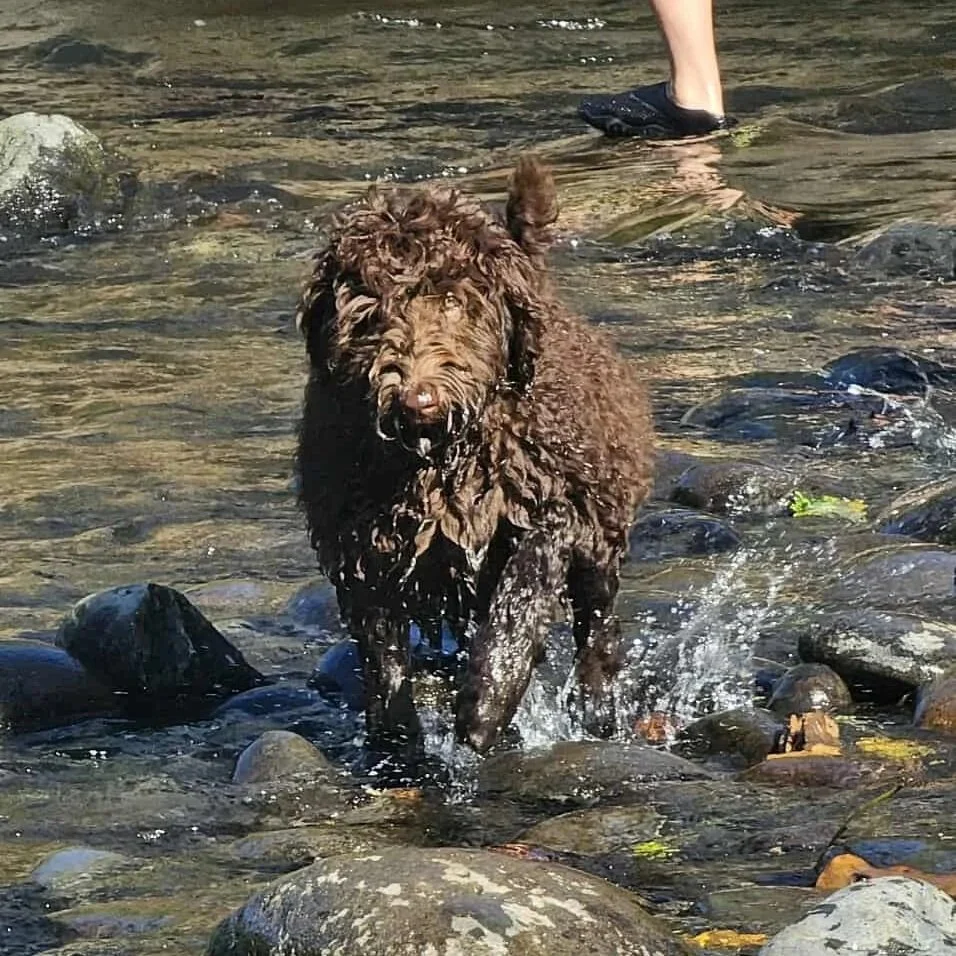
How Our Puppies Are Raised
Raising Confident Goldendoodle Puppies Starts Long Before Go-Home Day
One of the most common questions families ask is:
"How are your puppies actually raised?"
It is an important question.
The first eight weeks of a puppy's life help shape how they view people, respond to challenges, recover from stress, and interact with the world around them.
Those weeks are about far more than feeding puppies and keeping them safe.
They are an opportunity to begin building confidence, resilience, trust, problem-solving skills, and positive social experiences that will continue influencing the puppy long after they leave our home.
Our puppy raising program combines puppy socialization, age-appropriate exposure, confidence-building exercises, temperament observations, and real-world experiences designed to help puppies develop into adaptable family companions.
But this page is not simply a list of activities.
The goal is to help you understand why we do what we do, how those experiences help the puppy, and how they prepare families for the journey ahead.
At Oregon's Legendary Goldendoodles, one belief guides nearly everything we do:
The world is safe. People are kind. Dogs are friendly.
Everything that follows is designed to help puppies build trust in that idea.

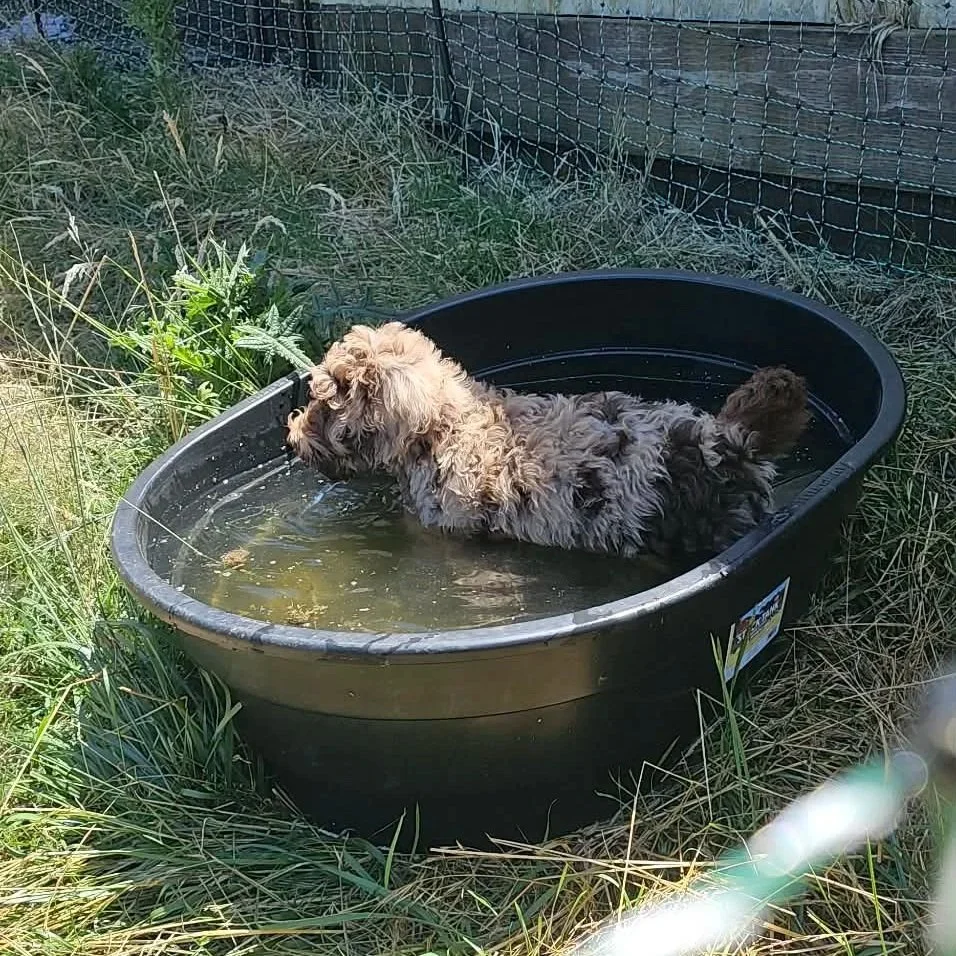
Frequently Asked Questions
-
Yes.
Our puppies are raised as part of our daily lives and experience a variety of environments including our home, yard, shop, barn, work office, and other carefully selected locations.
We believe what happens during those weeks matters far more than simply saying puppies are "raised in our home."
Our focus is building confidence, resilience, trust, and adaptability through intentional experiences and interactions.
-
We incorporate concepts from Puppy Culture, Badass Breeder, Early Neurological Stimulation (ENS), Early Scent Introduction (ESI), and our own years of hands-on experience.
Rather than following a curriculum blindly, we adjust based on what the puppies are showing us and what they are developmentally ready for.
The puppies determine the pace.
-
Our goal is not simply exposing puppies to as many people as possible.
We focus on helping puppies develop positive expectations about people, dogs, and new experiences.
Puppies experience visitors, family interactions, trusted socializers, office staff, construction crews, Puppy Yoga, adult dogs, littermates, and a variety of real-world environments.
The quality of the interaction matters more than the quantity.
-
Confidence develops when puppies successfully work through challenges.
Throughout puppyhood, we provide age-appropriate opportunities for problem solving, exploration, obstacle navigation, environmental exposure, and independent thinking.
The goal is helping puppies learn:
"I can recover."
"I can try again."
"I can do hard things."
-
Yes.
We perform formal temperament evaluations after puppies are developmentally ready, typically beginning no earlier than seven weeks of age.
Temperament testing is combined with weeks of observations, social experiences, developmental milestones, and real-world interactions to help us better understand each puppy as an individual.
-
We do not believe puppy selection should be based solely on color, gender, or first impressions.
Our goal is matching each family with the puppy that best fits their lifestyle, goals, experience level, and household needs.
Temperament, energy level, confidence, resilience, sociability, sensitivity, and trainability all play a role in the matching process.
-
At six weeks old, puppies are still developing rapidly.
Many important temperament traits become clearer through continued observation, social experiences, and formal evaluations.
By waiting until we have more complete information, we are able to provide families with better guidance and more accurate recommendations.
-
Because we believe families should be able to see the process.
Photos are wonderful, but videos allow families to observe puppies learning, exploring, problem solving, recovering from challenges, and interacting with the world around them.
We want families to understand how their puppy is being raised, not simply see the finished product.
-
Our role is providing the foundation.
Your role is continuing to build on it.
Puppies continue developing rapidly throughout the first 16 weeks of life, which is why we place such a strong emphasis on educating and supporting families before and after go-home day.
Learn more in our Bringing Home Your Goldendoodle Puppy Guide.
-
No.
No ethical breeder can guarantee the exact temperament of a developing puppy.
What we can do is carefully evaluate each puppy, share what we are observing, explain strengths and challenges, and help families choose the puppy that is most likely to thrive in their particular home.