
What Is The Difference Between A Flat, Straight, Wavy, Curly and Ultra Coat?
One of the most common questions we receive is:
"What coat type should I choose?"
The answer depends on much more than appearance.
When most families begin researching Goldendoodles, they focus on what they see in photographs. They may know they like a certain look but have little understanding of the genetics, grooming requirements, maintenance, and ownership experience that come with different coat types.
The reality is that coat type influences far more than appearance. It affects shedding expectations, grooming requirements, coat maintenance, how the coat behaves in different environments, and even how the dog looks after a trip to the groomer.
Understanding the differences can help you choose a puppy whose appearance, maintenance requirements, and lifestyle fit are right for your family.
Flat • Straight • Wavy • Curly • Ultra
Flat Coat Goldendoodles
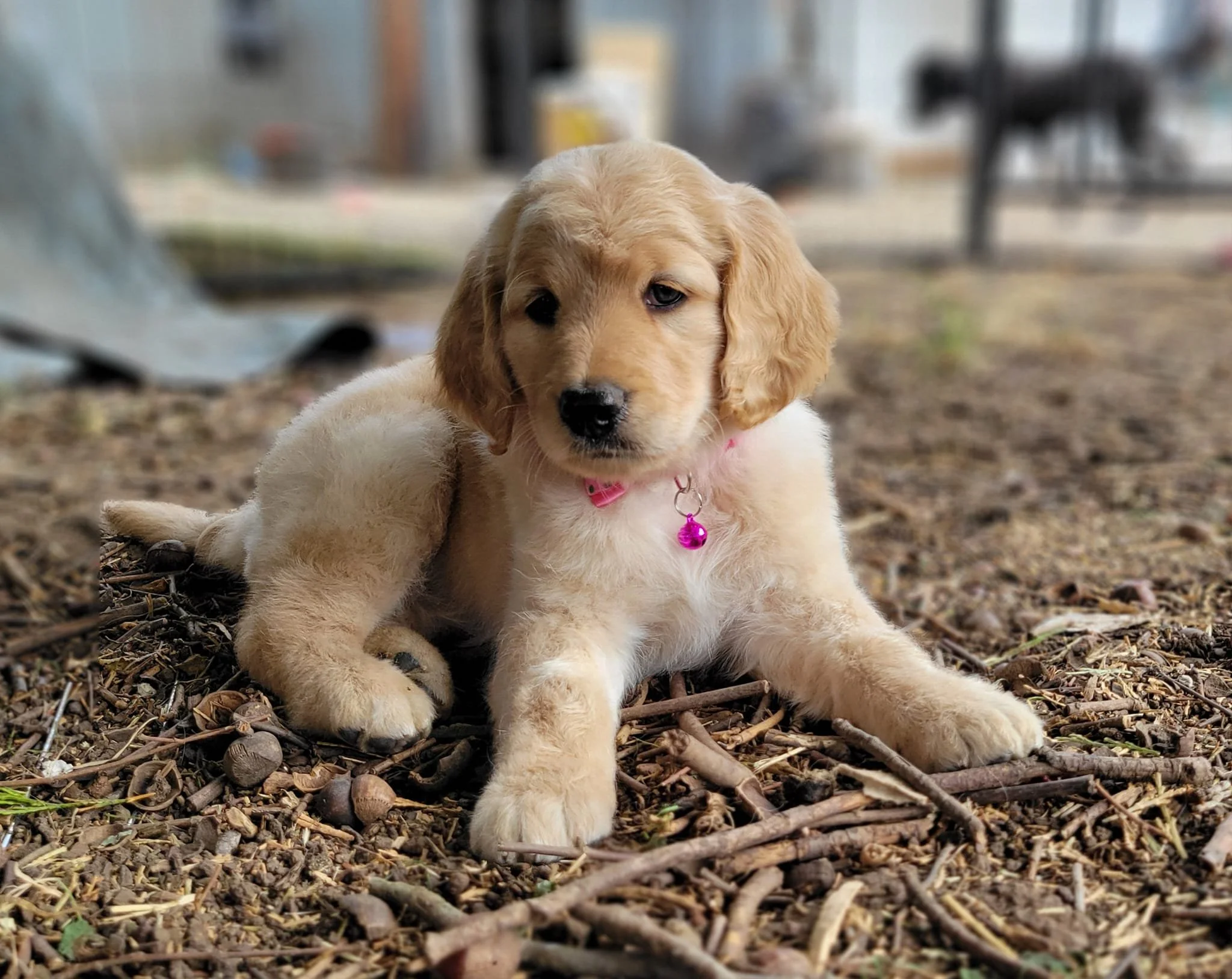
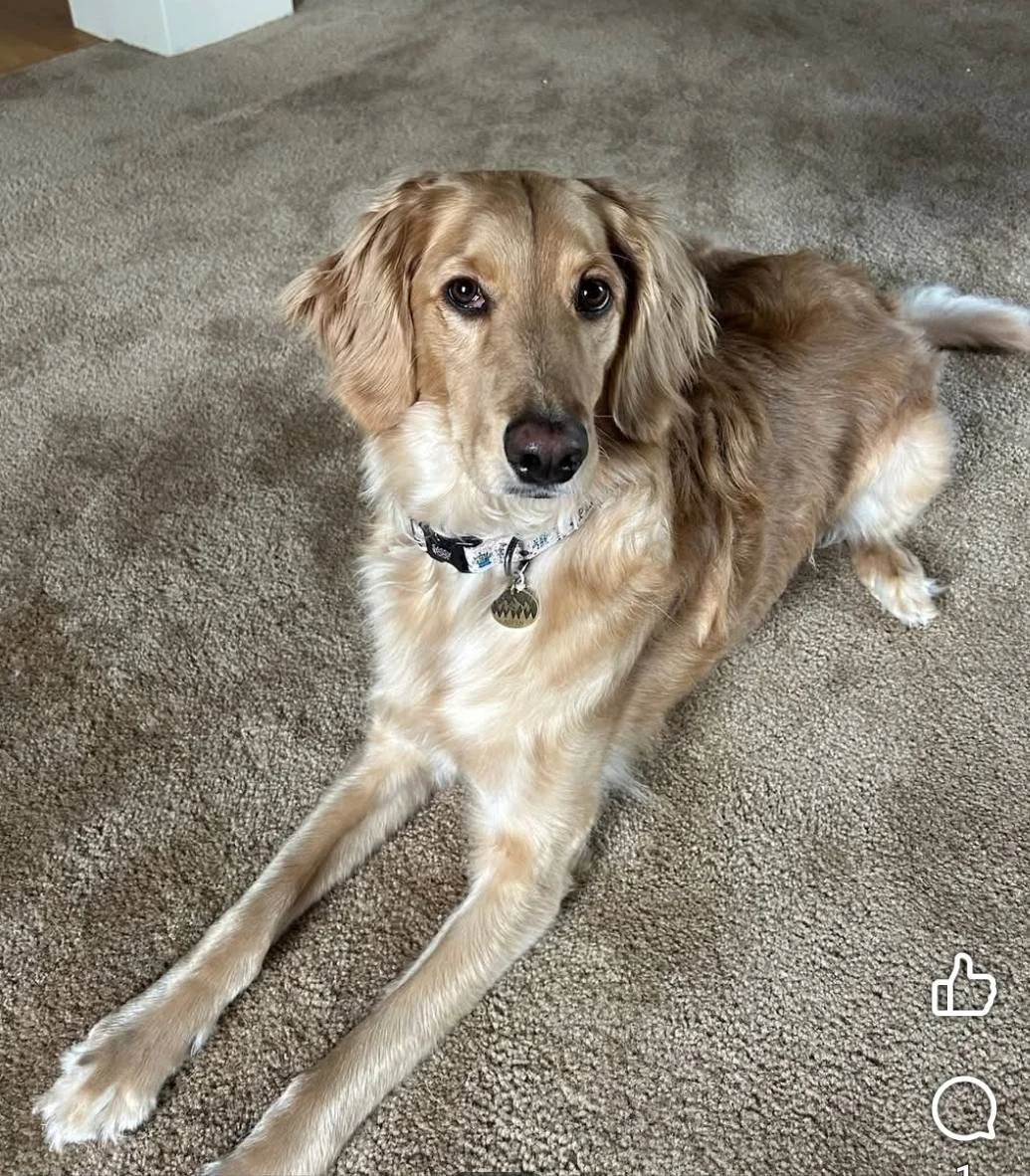
Aspen (Formerly Poptart) Dixie x Whiskey 2024 - Flat-coated, single curl
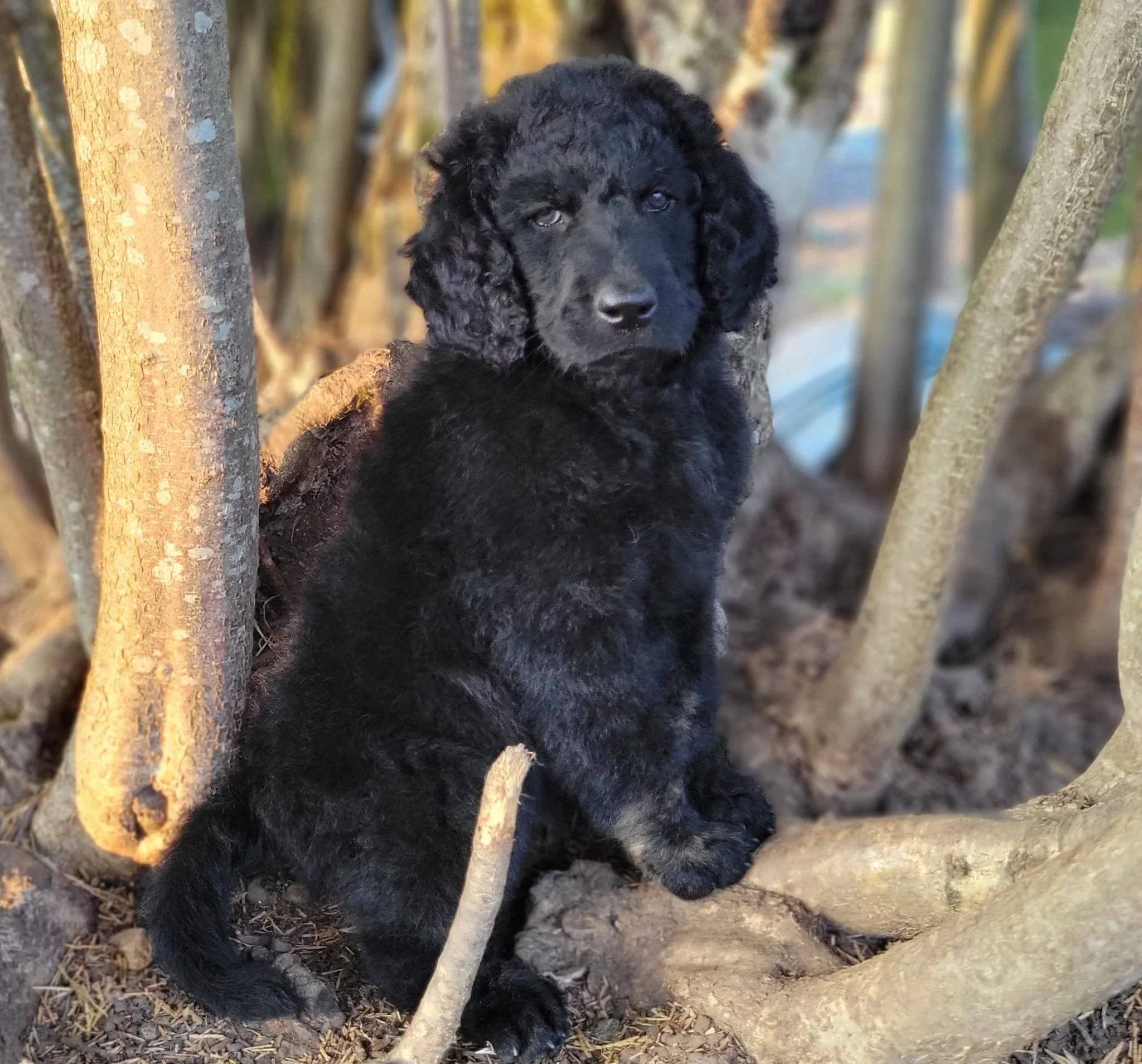
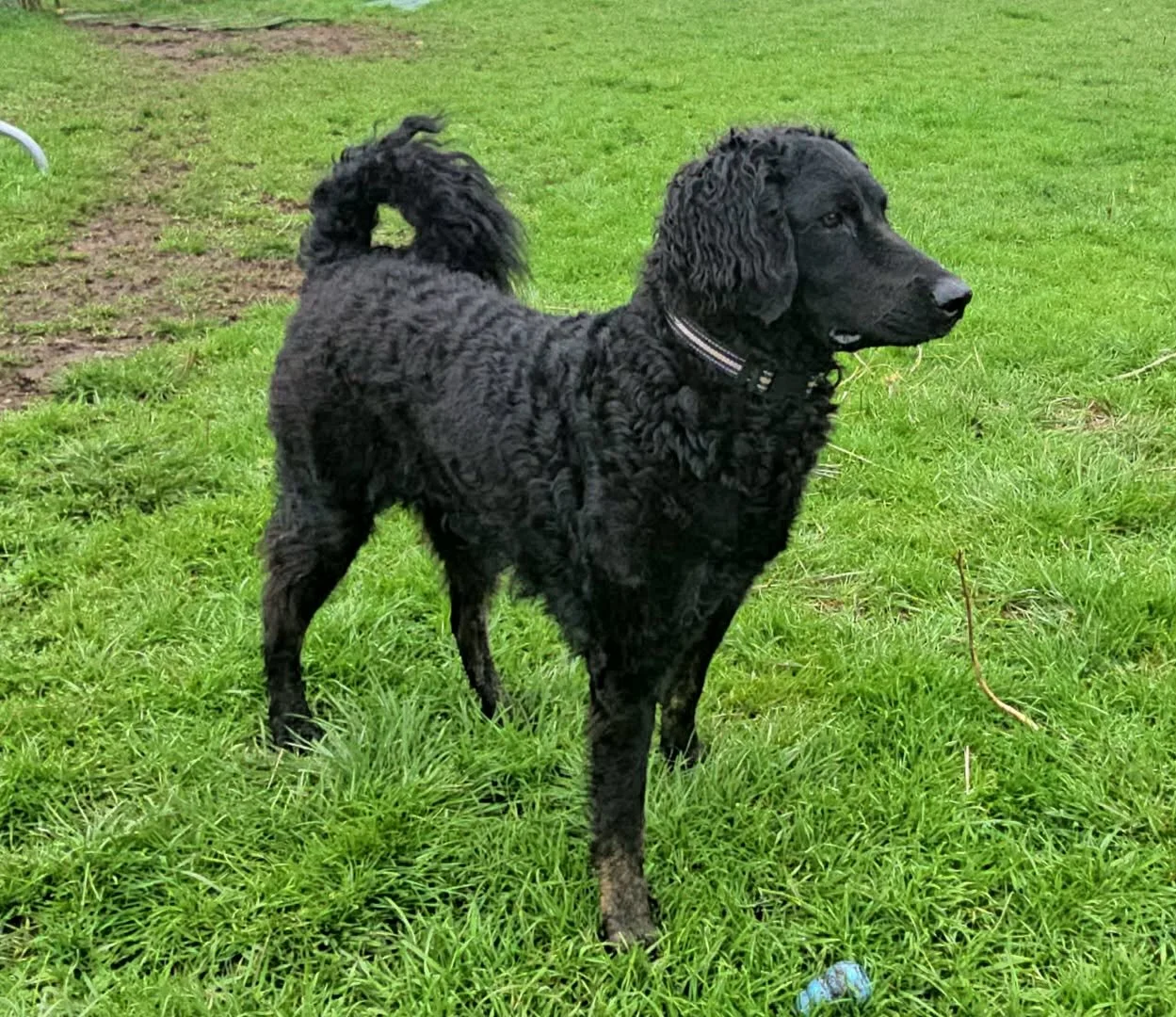
Blue (Formerly Muffin) Dixie x Whiskey 2024 - Flat-coated, single curl
Appearance
Flat-coated Goldendoodles are typically unfurnished, meaning they lack the beard, eyebrows, and facial furnishings most people associate with Goldendoodles.
They often have the most natural appearance of all Goldendoodle coat types and may resemble a Golden Retriever more closely than a traditional doodle.
They typically show:
little to no facial furnishings
a smooth, natural coat
a more retriever-like appearance
minimal visible curl
Shedding
Shedding expectations vary based on genetics, but flat coats generally behave more like traditional fur coats than furnished Goldendoodle coats.
Families considering a flat coat should understand that the ownership experience is often much closer to living with a Golden Retriever than a furnished Goldendoodle.
Coat Characteristics
This coat type often:
requires less professional grooming
requires fewer haircuts
dries quickly
has a more natural appearance
behaves more like a traditional double-coated breed
Best For
Families who:
prefer a natural appearance
are not concerned about shedding
prefer less professional grooming
enjoy the look of a retriever-type coat
While flat coats can be a great fit for some homes, many families requesting a flat coat are focusing primarily on appearance without fully understanding the coat expectations that often come with it. Families attracted to flat coats should understand that the ownership experience is often closer to a Golden Retriever than a furnished Goldendoodle.
Oakley (Formerly Honey Bun) Dixie x Whiskey 2024 -
Flat-coated, single curl
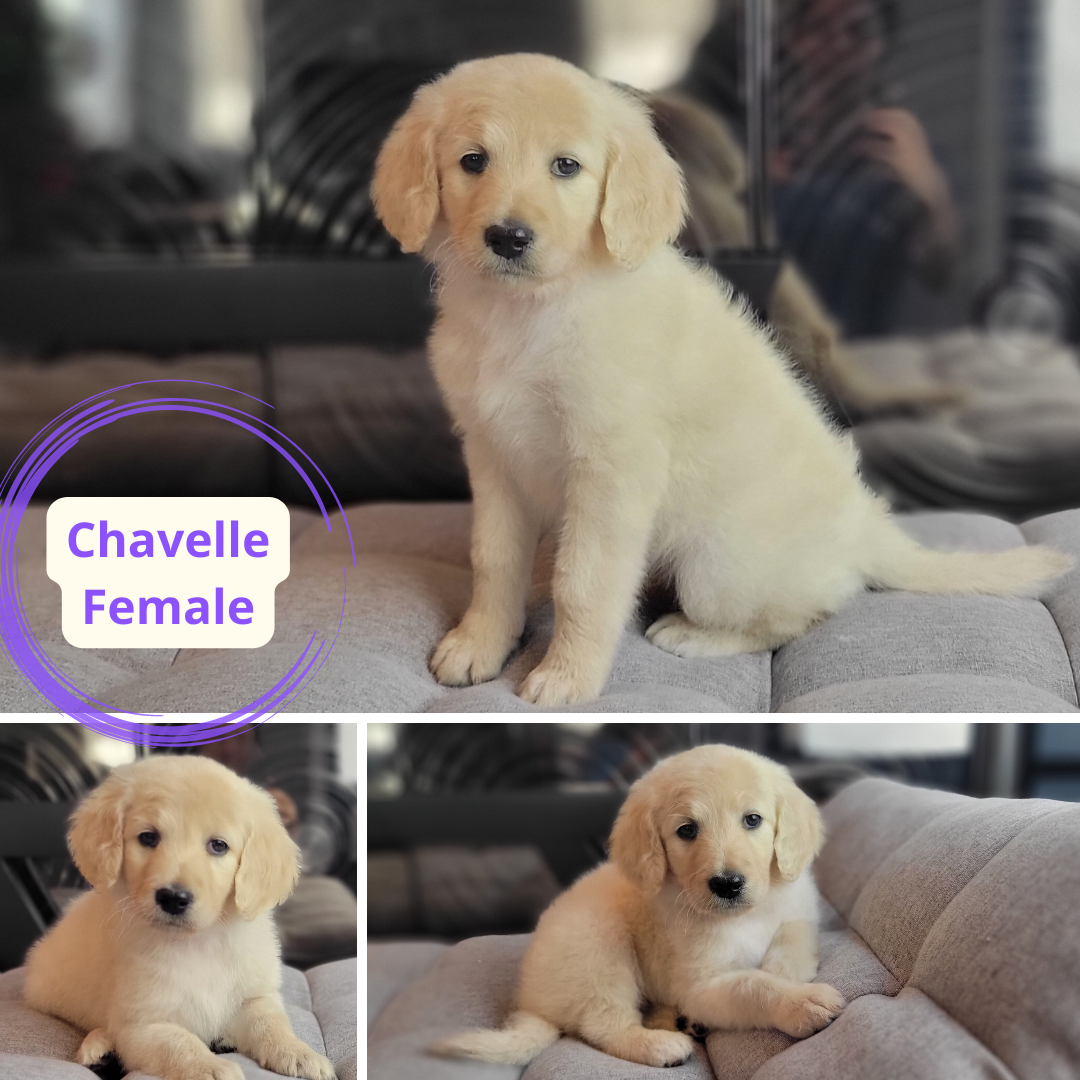

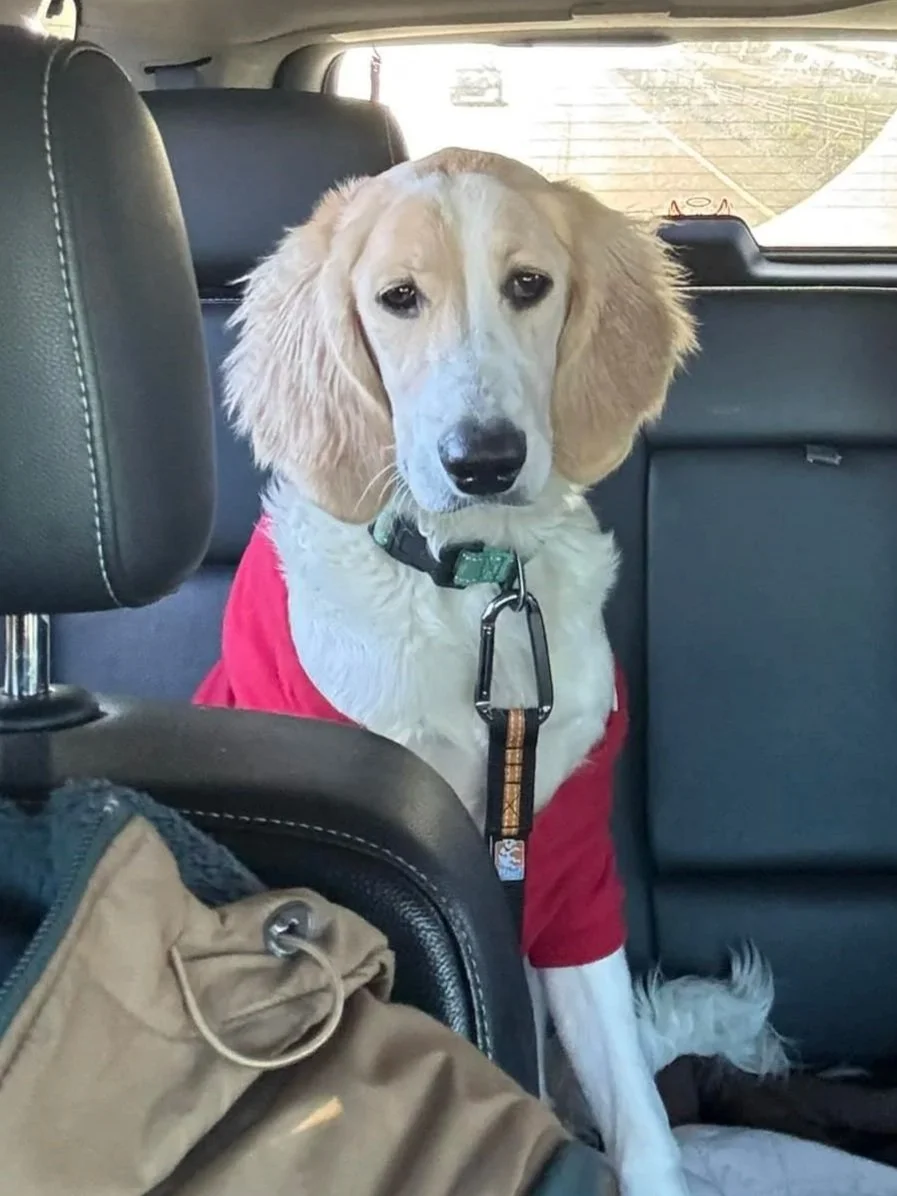
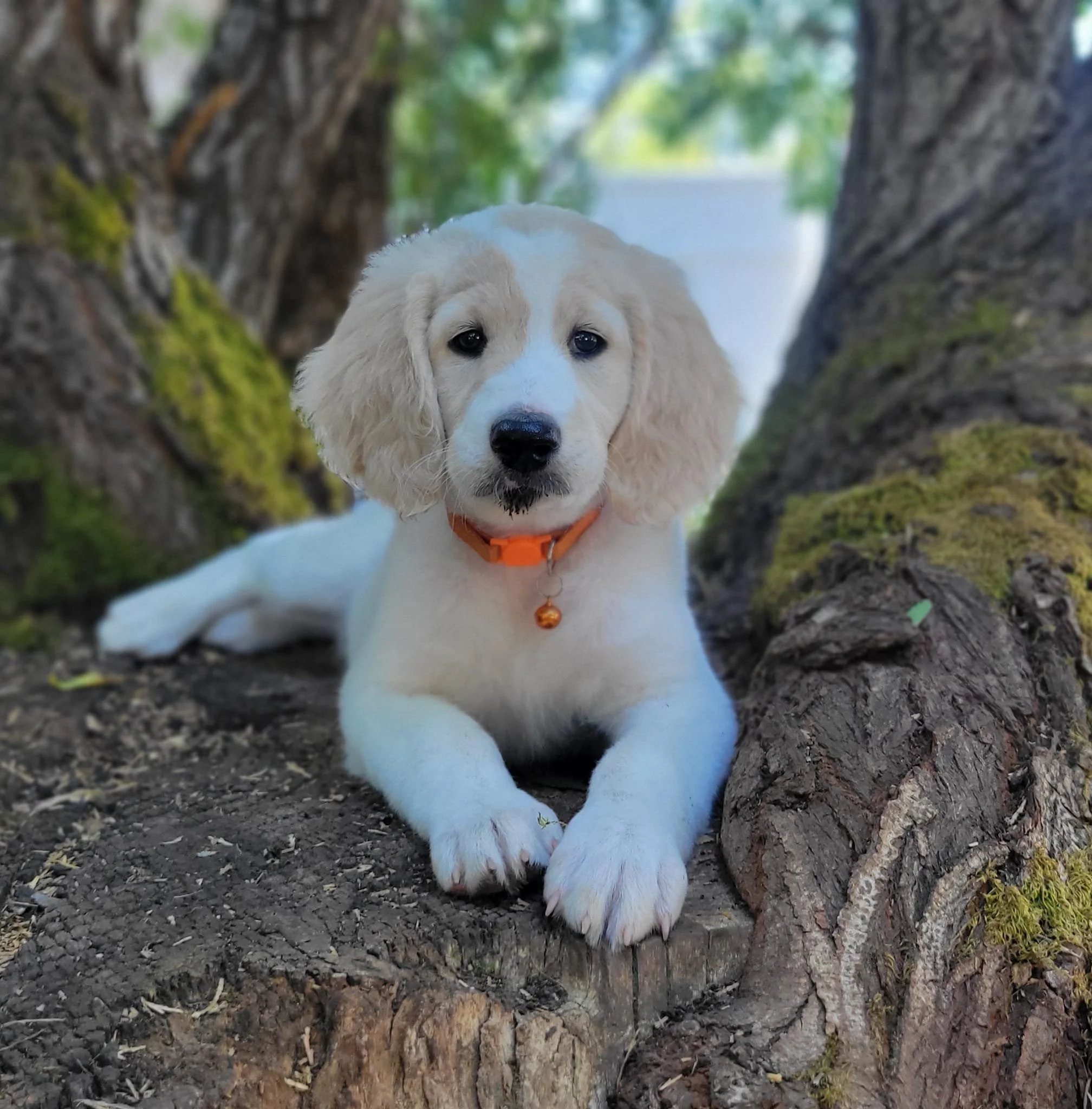
(Formerly Chavelle) Dixie x Whiskey 2023 - Flat-coated, single curl
Straight Coat Goldendoodles (Furnished)
Appearance
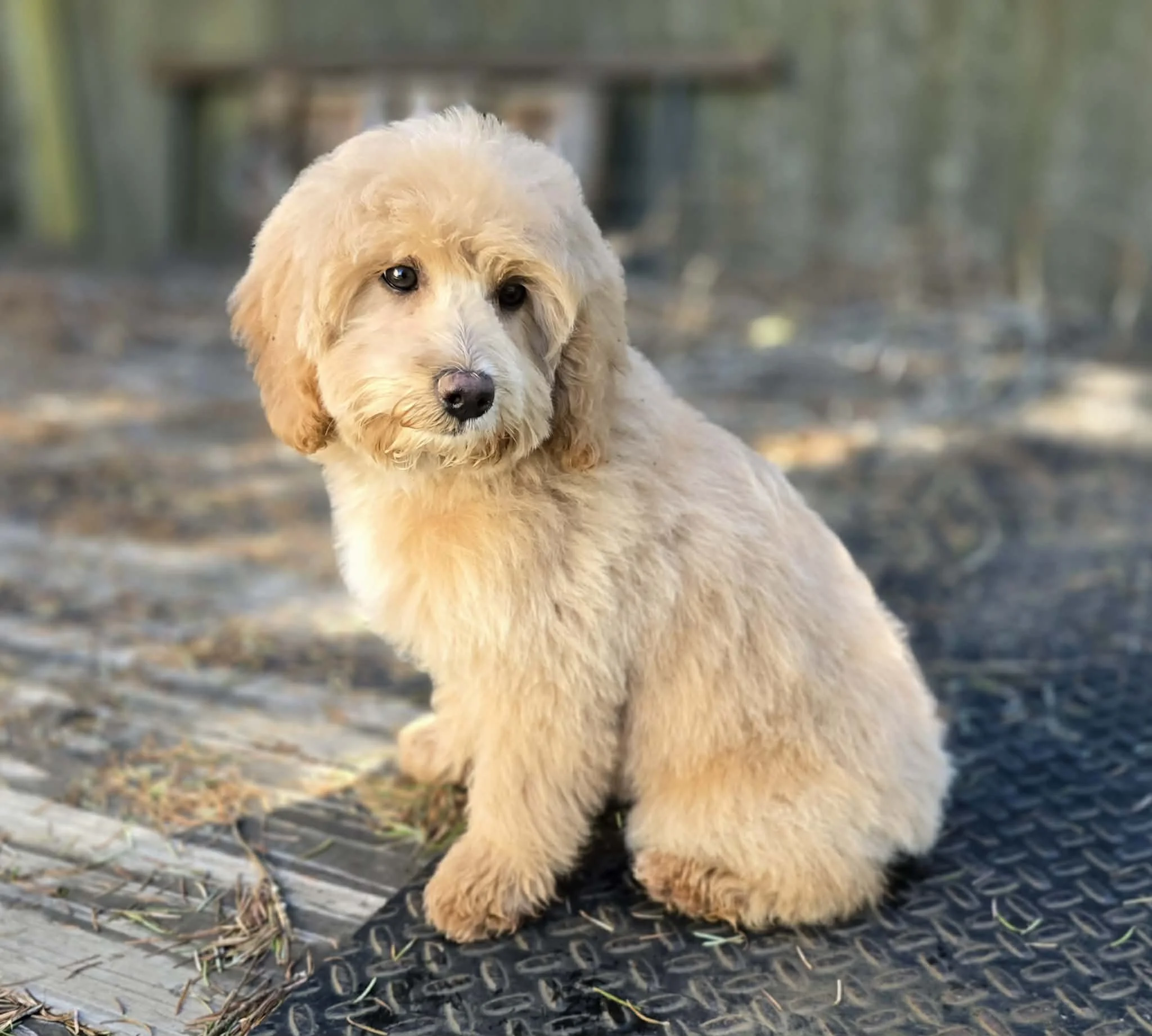
Straight coat Goldendoodles are genetically furnished but have a straighter overall coat with little visible curl.
Many families seeking a Golden Retriever-inspired appearance are actually drawn to furnished straight coats because they maintain the facial furnishings associated with Goldendoodles.
They typically show:
full facial furnishings
a natural appearance
minimal curl
softer expression
a less stylized look
Shedding
Shedding expectations are often lower than flat coats, although individual genetics still matter.
This coat generally creates a very different ownership experience than living with a traditional shedding retriever.
Coat Characteristics
This coat type often:
grows more slowly than dense curly coats
requires fewer haircuts
is easier to maintain than many heavily curled coats
holds a natural appearance well
Best For
Families who:
like a Golden Retriever-inspired appearance
want facial furnishings
prefer a lower-maintenance coat
do not want a heavily curled doodle
This coat often provides one of the best balances between appearance, maintenance, and everyday livability.
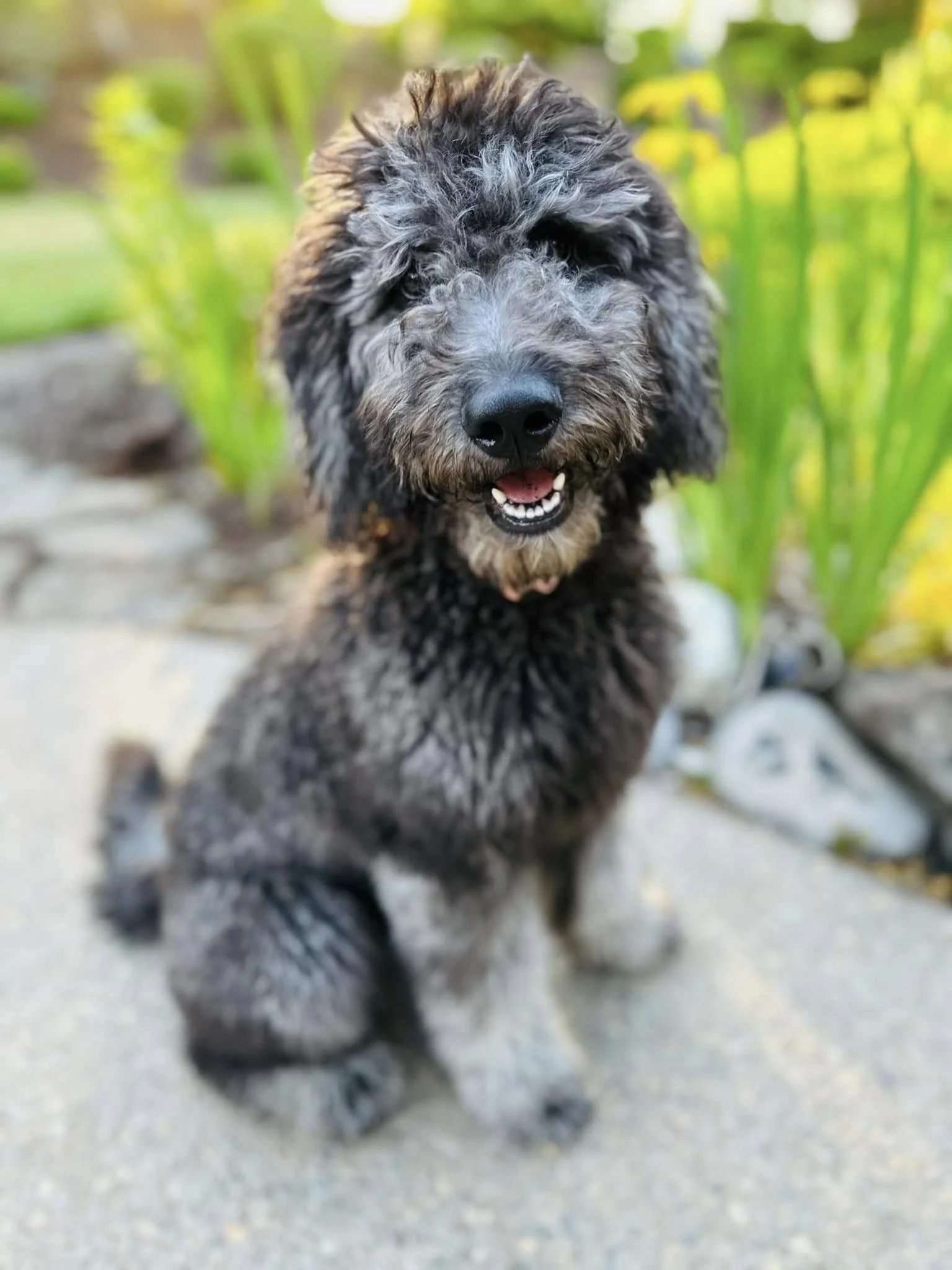
Wavy Coat Goldendoodles
Appearance
The wavy coat is often considered the classic Goldendoodle coat.
It combines facial furnishings with loose waves, creating the familiar doodle appearance many families recognize.
They typically show:
full facial furnishings
loose waves
a soft expression
a classic teddy bear appearance
Shedding
Most wavy coats have lower shedding expectations than flat coats, although individual genetics still influence coat behavior.
Coat Characteristics
This coat type often:
offers a balance between appearance and maintenance
works well in a variety of grooming styles
can be kept natural or styled
varies significantly based on texture and density
Not all wavy coats are the same. Two dogs may both have wavy coats while feeling completely different to the touch and requiring different maintenance routines.
Best For
Families who:
want the classic Goldendoodle look
want furnishings without heavy curl
enjoy grooming flexibility
want a balance between maintenance and appearance
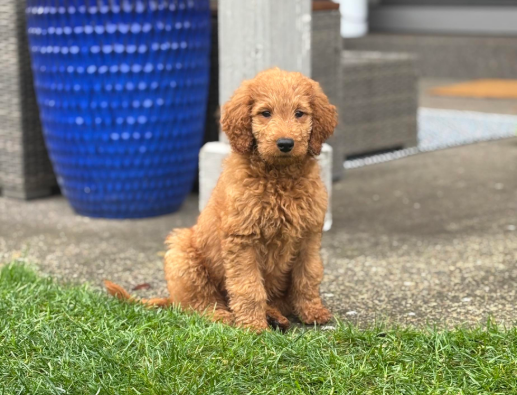
Curly Coat Goldendoodles
Appearance
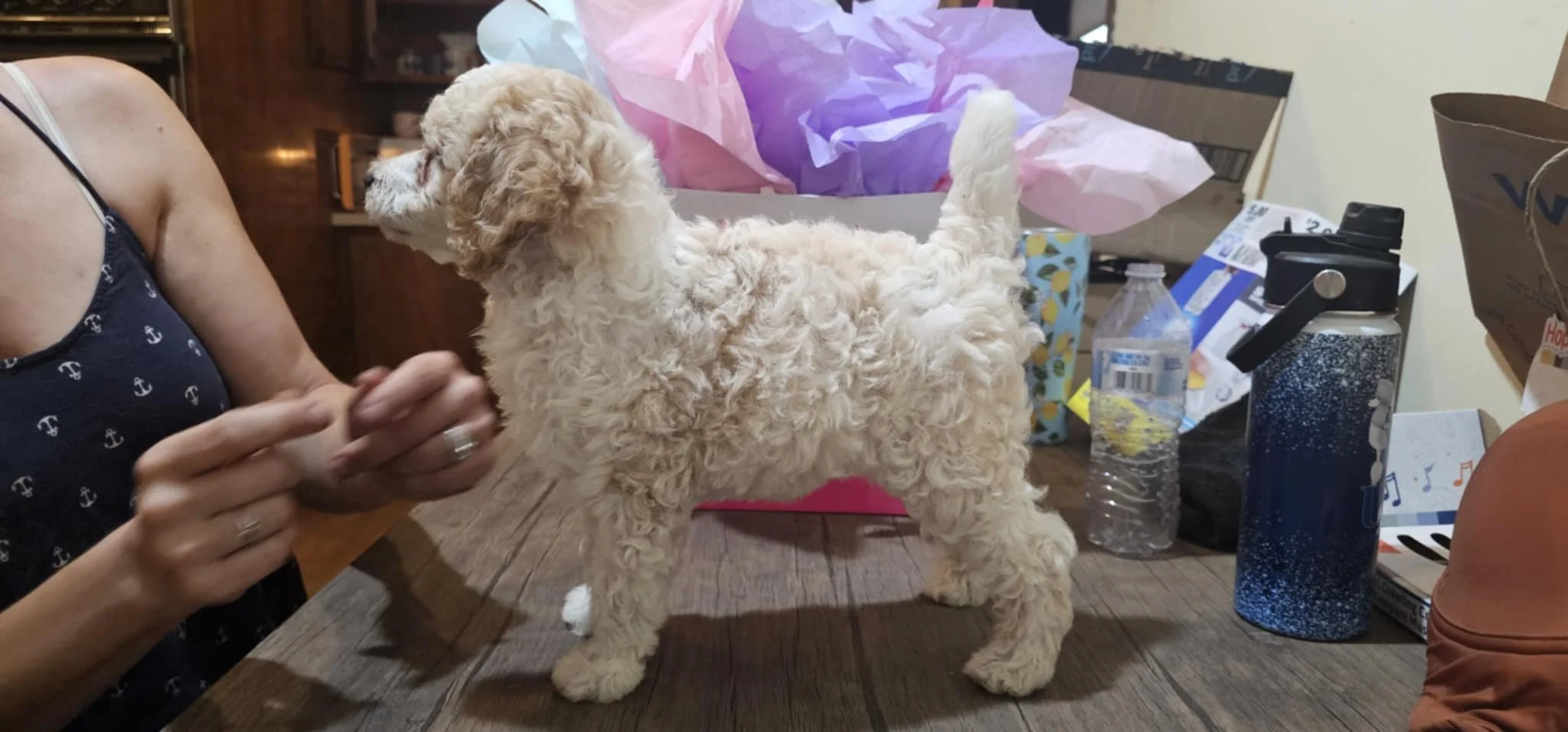
Curly coats show the strongest visible Poodle influence.
These coats range from loose curls to very dense curl patterns and often create the fullest doodle appearance.
They typically show:
full facial furnishings
significant curl
maximum coat volume
strong Poodle influence
Shedding
Curly coats are often sought by families looking for the coat characteristics commonly associated with allergy-friendly dogs.
However, curl alone does not determine coat behavior. Texture, furnishings, and genetics all contribute.
Coat Characteristics
This coat type often:
requires the most grooming commitment
develops the greatest coat volume
benefits from regular maintenance
offers the widest range of styling options
Many families assume all curly coats feel soft. In reality, a correct Poodle coat is often denser and somewhat coarser than expected. This texture helps support the structure and curl pattern the breed is known for.
Best For
Families who:
enjoy grooming and coat maintenance
prefer a fuller doodle appearance
want maximum curl
are committed to regular professional grooming
Curly coats can be beautiful, but they are generally not the lowest-maintenance option.
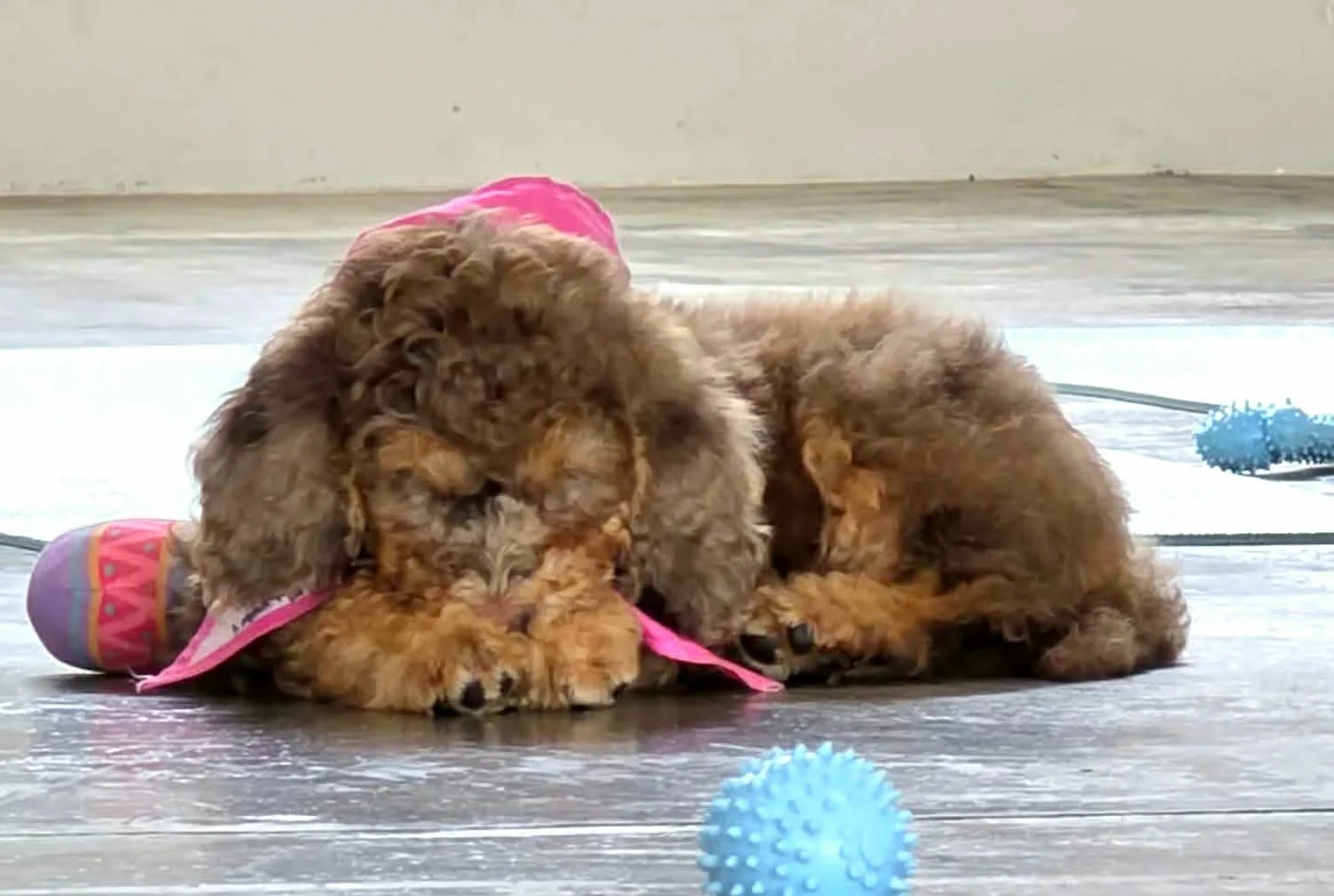
Ultra Coat Goldendoodles
Appearance
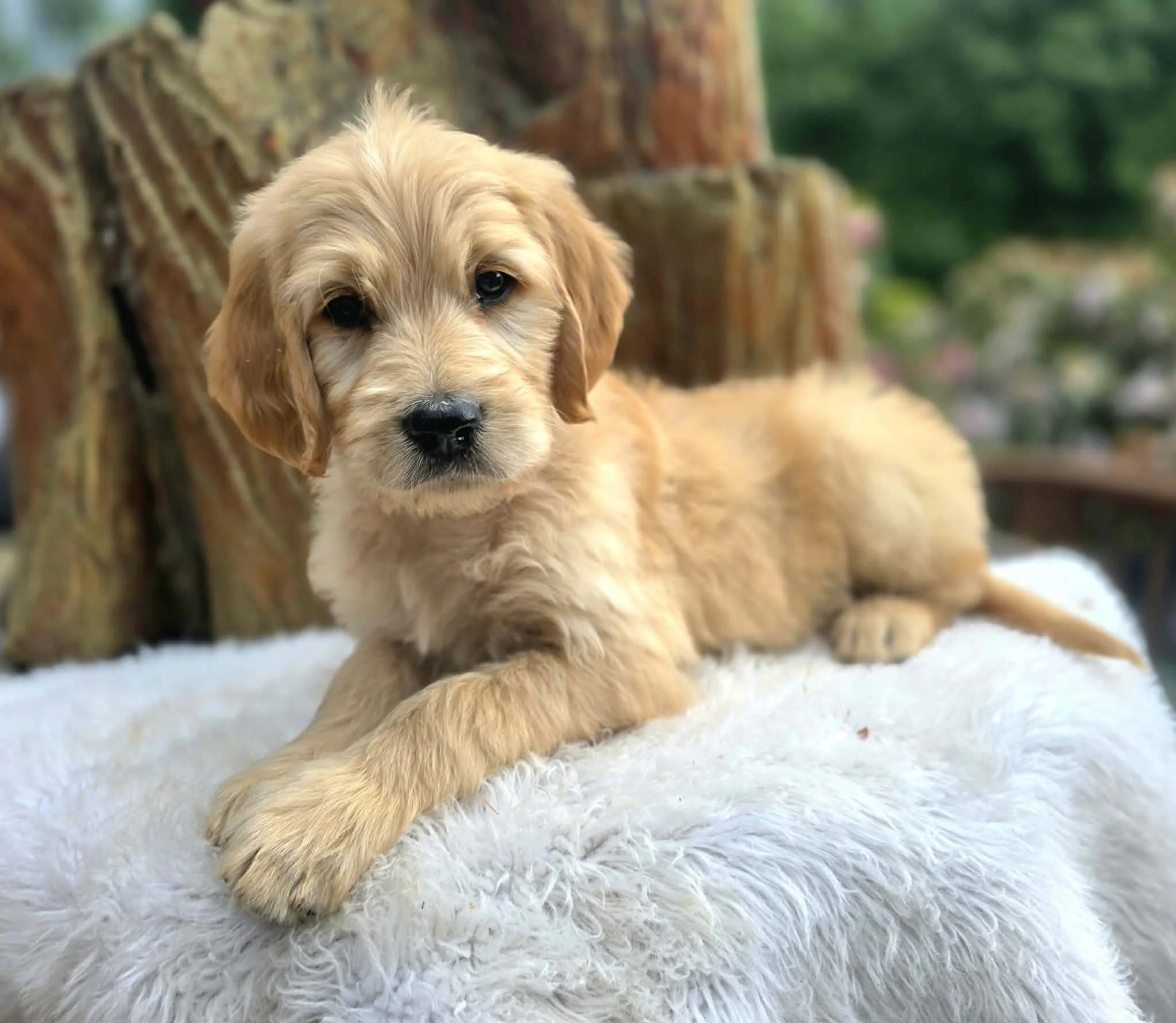
The Ultra Coat is not an official genetic classification. Instead, it is a coat style we intentionally strive for within some of our Golden Retriever-influenced lines.
These coats often combine many of the visual qualities families love about Golden Retrievers with the coat behavior commonly associated with furnished Goldendoodles.
They typically show:
a full straight to loose wavy appearance
full facial furnishings
softer expression
Golden Retriever influence
a natural overall look
Shedding
While individual genetics always matter, these coats are often sought by families wanting a furnished coat without the ownership experience associated with a heavily shedding retriever.
Coat Characteristics
This coat type often:
has a natural appearance
grows more slowly than dense curly coats
requires less maintenance than many heavily curled coats
retains a softer, sporting-dog look
Not every Ultra Goldendoodle has an Ultra Coat, and not every Ultra Coat looks exactly the same. It is simply a term we use to describe a coat style that aligns closely with the goals of our Ultra Goldendoodle program.
Straight Coat vs Ultra Coat
While Straight and Ultra coats may appear similar at first glance, the terms describe different things.
A Straight coat refers primarily to coat type. It describes how the coat grows and how much curl is present.
Ultra refers to an intentional style of Goldendoodle that combines Golden Retriever influence, structure, expression, head type, and coat characteristics working together.
Not every straight-coated Goldendoodle would be considered an Ultra Goldendoodle, and not every Ultra Goldendoodle has the exact same coat.
The coat is only one piece of the picture.
Best For
Families who love Golden Retriever influence
Families wanting a natural appearance
Families wanting furnishings
Families seeking easier maintenance than many curly coats
Families who prefer a more sporting-dog look
For many families, the Ultra Coat represents a balance between the appearance they love and the maintenance they can realistically live with.
The Genetics Behind The Coat
A Goldendoodle's coat is influenced by several different genetic factors.
The most important are:
Furnishings
Furnishings create the beard, eyebrows, mustache, and facial hair most people associate with Goldendoodles.
Curl
Curl influences whether a coat appears straight, wavy, or curly.
Texture
Texture affects how a coat feels, how it lays against the body, and how it behaves during grooming.
Density
Density influences the amount of coat present and how much volume the coat develops.
Shedding Traits
Shedding genetics influence whether a coat behaves more like a traditional fur coat or a hair coat.
Because multiple genes work together, two Goldendoodles can look surprisingly different even when they come from similar breeding combinations.
Genetics Create The Coat. Grooming Creates The Look.
One of the biggest misconceptions about Goldendoodles is that appearance is determined entirely by genetics.
Genetics certainly matter. Structure, furnishings, curl pattern, coat texture, and coat type all influence how a dog looks.
However, grooming often plays a much larger role than many families realize.
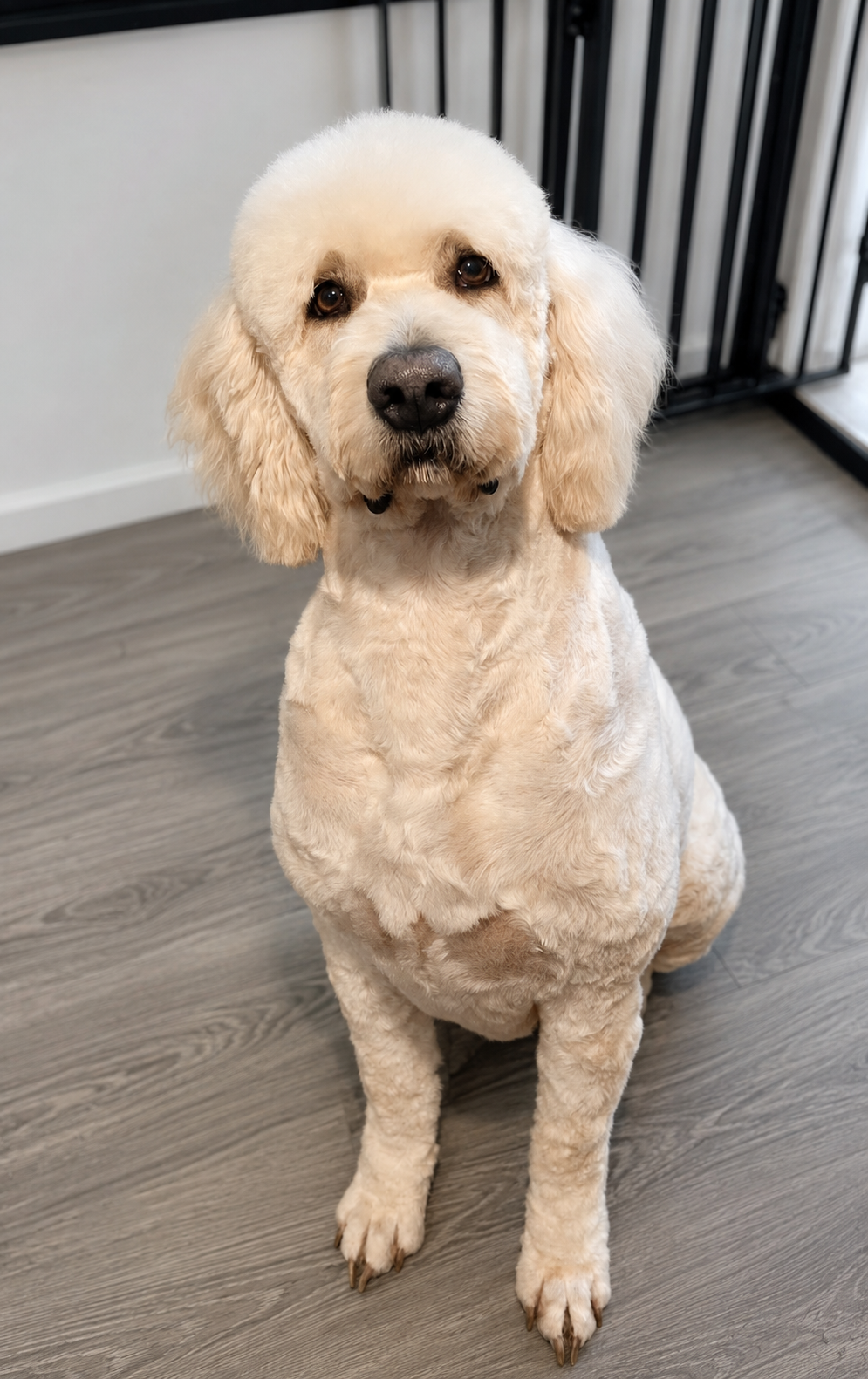
The same Goldendoodle can look dramatically different depending on how it is groomed.
Stella- Same dog. Different grooming and coat length.
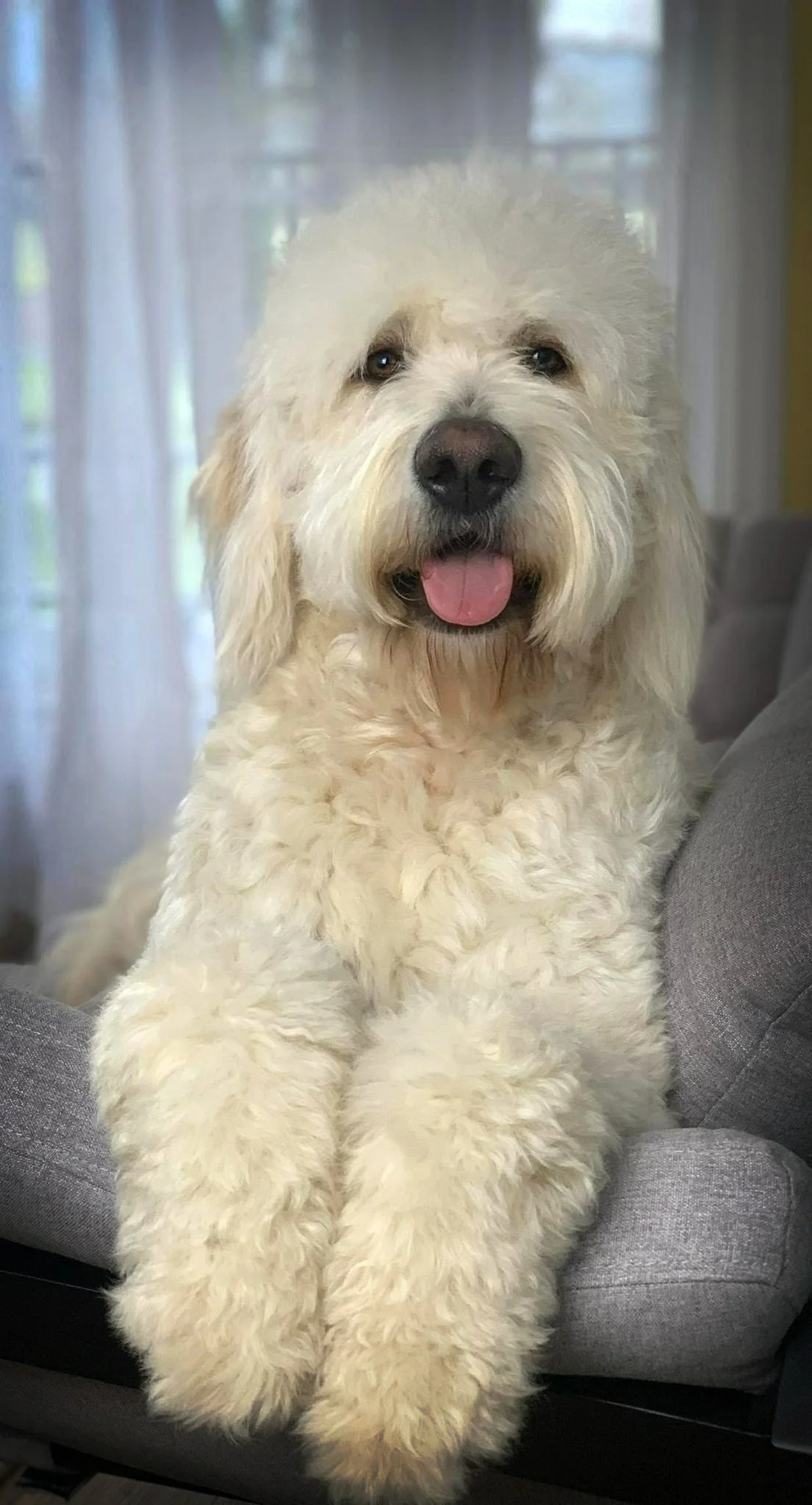
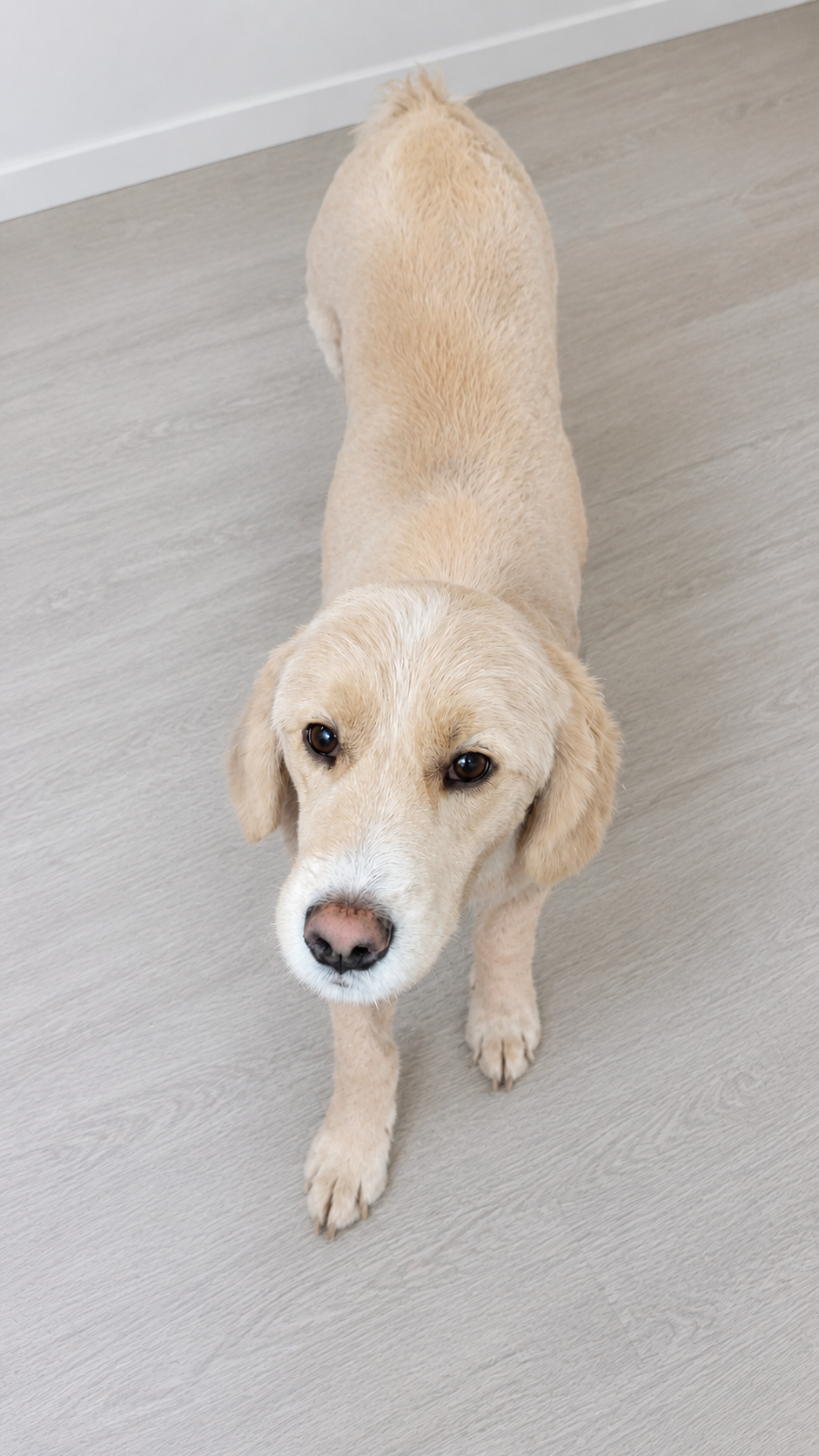
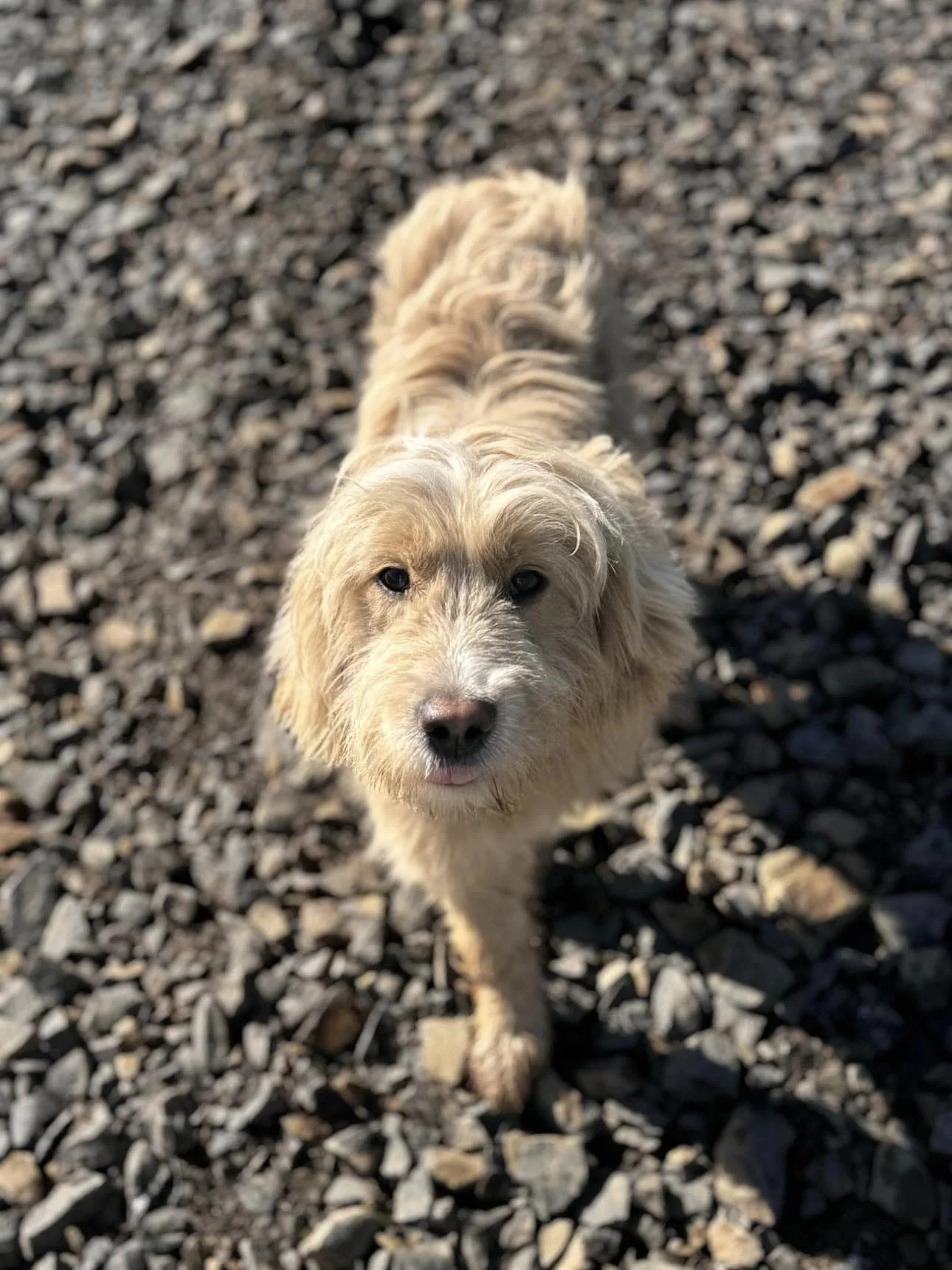
Lady - Same dog. Different grooming and coat length.
Many people assume they are looking at different coat types when they compare photos online. In reality, they are often looking at different grooming styles.
For example:
A longer, more natural muzzle trim often creates a more sporting or Golden Retriever-inspired appearance.
A shorter, rounded muzzle creates the classic teddy bear look.
Longer ear furnishings create a softer expression.
A shorter sporting trim creates a cleaner, more athletic appearance.
A longer body coat creates a fuller, fluffier look, while shorter trims emphasize structure and movement.
When families tell us they love the "Golden Retriever look," they are usually responding to a combination of factors working together:
Structure
Head shape
Muzzle shape
Coat type
Grooming style
This is one reason two Goldendoodles with similar genetics can look surprisingly different in photographs.
Grooming does not change genetics or structure. It simply influences how those traits are presented.
Furnished vs Unfurnished Goldendoodles
One of the most important concepts families can understand is furnishings.
In fact, furnishings often influence appearance more than curl pattern alone.
Furnishings create the:
Beard
Mustache
Eyebrows
Facial furnishings
When most people picture a Goldendoodle, they are usually picturing a furnished dog.
Furnished
Straight coats
Wavy coats
Curly coats
Ultra coats
Unfurnished
Flat coats
This is why a straight-coated Goldendoodle and a flat-coated Goldendoodle can look dramatically different despite both having very little curl.
Furnishings create the beard, eyebrows, and facial hair most people associate with Goldendoodles. A straight coat may have very little curl, but because it is furnished, it presents very differently than a flat coat.
Hair Coats vs Fur Coats
Another common misconception is that all shedding behaves the same way.
It does not.
Golden Retrievers have a fur coat.
Most furnished Goldendoodles have a hair coat.
While both technically shed individual hairs, the ownership experience is often very different.
A useful comparison is human hair.
People lose hair every day.
Someone with straight hair may notice those hairs falling away naturally.
Someone with curly hair often finds those loose hairs remain trapped within the curl pattern until brushing, washing, or grooming.
Goldendoodle coats often behave similarly.
This is one reason many families experience a dramatic difference between living with a furnished Goldendoodle and living with a heavily shedding retriever.
In our own home, living with furnished Goldendoodles is a very different experience than living with Golden Retrievers. We are not finding hair covering clothing, furniture, vehicle interiors, and corners of the house in the same way we experience with traditional shedding breeds.
Flat coats remain the primary exception and should generally be expected to behave more like traditional fur coats than furnished Goldendoodle coats.
If you'd like to learn more about shedding expectations, coat behavior, and allergy considerations, see our Shedding & Allergies: What Families Need To Know guide.
Coat Texture Matters
When families discuss coat type, they often focus entirely on curl pattern.
In reality, curl pattern and coat texture work together to create the finished appearance.
Texture influences:
How the coat lays
How much volume it develops
Whether it appears fluffy or flowing
Which grooming styles it holds best
How quickly tangles develop
How much maintenance it requires
Some Goldendoodles have:
Soft Fleece Coats
Extremely soft feel
Plush appearance
Often associated with the classic teddy bear look
Silky Coats
Smoother texture
More flowing appearance
Often seen in Golden Retriever-influenced lines
Denser Poodle-Type Coats
More structure
Stronger curl support
Greater coat volume
Often associated with a correct Poodle coat
Many people assume a correct Poodle coat should feel soft.
In reality, a correct Poodle coat is often denser and somewhat coarser than expected. That texture helps support the structure and curl pattern the breed is known for.
This is one reason two dogs can both have wavy coats—or both have curly coats—while feeling completely different to the touch and requiring very different grooming routines.
Why Puppy Coats Change
One of the most common questions we hear is:
"Will my puppy keep this coat?"
Maybe.
Puppies are born with a puppy coat.
As they mature, that puppy coat is gradually replaced by the adult coat.
During this transition, families may notice:
Increased curl
Reduced curl
More furnishings developing
Texture changes
Increased coat density
Changes in overall appearance
This process can take many months and often continues well into adolescence.
For this reason, a young puppy's appearance is not always an exact reflection of what the adult coat will ultimately become.
Can Coat Type Be Predicted?
To a degree, yes.
Experienced breeders can often make educated predictions based on:
Genetics
Furnishings
Parent coats
Known pedigrees
Coat testing
However, coat development is influenced by multiple genetic factors working together.
Some predictions become easier as puppies mature and the coat begins to develop.
The goal is not perfect certainty.
The goal is providing realistic expectations based on genetics, experience, and what the puppy is showing as it grows.
No responsible breeder should promise a specific adult coat with absolute certainty.
The closer a breeder understands their genetics and their lines, the more accurate those predictions generally become.
If you're interested in learning more about how genetics and testing influence predictability, visit our Health Testing page.
Real-World Coat Care
What We Have Learned About Coat Care
One of the challenges families face when researching Goldendoodle grooming is sorting through the enormous amount of conflicting advice online.
Some sources insist every Goldendoodle must be brushed every day.
Others suggest certain coats are nearly maintenance-free.
The reality is much more nuanced.
Over the years, we have maintained everything from pet coats to competition Poodle coats ranging from UKC Modern trims to full AKC Continental trims. Those experiences have reinforced one simple lesson:
Different coats have different needs.
The maintenance required for a coat is heavily influenced by:
Coat type
Curl pattern
Texture
Density
Coat length
Grooming style
Daily activities and lifestyle
A short straight coat that spends most of its time indoors may require a very different maintenance routine than a long curly coat that regularly swims, hikes, plays in snow, or spends time outdoors.
This is why blanket grooming advice often falls short.
The goal is not to brush as often as possible.
The goal is to maintain a healthy coat that remains comfortable, manageable, and free of tangles and matting.
Healthy Coats Are Easier To Maintain
Many families assume matting happens because they did not brush enough.
In reality, coat condition often plays a major role.
Dry, damaged coats tend to tangle more easily than healthy, conditioned coats.
Healthy coat care focuses on prevention rather than correction.
Regular bathing, proper conditioning, quality grooming products, and consistent maintenance often do more to keep a coat healthy than simply brushing more frequently.
The goal is not to wait until a coat becomes tangled and then spend an hour fighting through mats.
The goal is to prevent those tangles from forming in the first place.
A healthy, conditioned coat is often easier to maintain than a dry, damaged coat—even when the healthy coat is significantly longer.
Mats Are Easier To Prevent Than Remove
Once mats begin to form, grooming becomes more difficult for both the dog and the owner.
Brushing becomes less comfortable.
Dogs become less cooperative.
Owners become more frustrated.
This is why preventative maintenance matters.
Small tangles are usually quick and easy to address.
Large mats are often uncomfortable, time-consuming, and may ultimately require professional grooming to resolve.
The earlier coat issues are addressed, the easier they are to manage.
When Life Happens
Not every coat is going to be perfectly maintained at all times.
Dogs go swimming.
Families get busy.
Grooming appointments get pushed back.
Life happens.
Most owners will eventually encounter an overgrown coat, a developing mat, or a grooming situation they wish they had addressed sooner.
That does not make you a bad owner.
It makes you normal.
When a coat becomes difficult to manage, the goal should shift from preserving length to restoring comfort and coat health.
Sometimes that means increasing maintenance at home.
Sometimes it means scheduling a grooming appointment sooner than planned.
Sometimes it means choosing a shorter trim and starting fresh.
A shorter coat is not a failure.
In many situations, it is the most responsible and compassionate choice.
A comfortable dog with a healthy coat is always more important than preserving coat length.
The goal is not perfection.
The goal is maintaining a coat that fits your lifestyle and a dog that enjoys being groomed.
A Grooming Table Can Change Everything
One of the simplest tools that can improve home grooming is a grooming table.
Many owners struggle with brushing because the dog is moving around the floor, couch, or yard during maintenance.
A grooming table creates a consistent workspace and often makes brushing safer, easier, and more comfortable for both the dog and the owner.
It also allows owners to reach areas commonly missed during casual brushing, including:
Behind the ears
Armpits
Legs and furnishings
Chest
Belly
For families planning to perform routine coat maintenance at home, a grooming table is often one of the best investments they can make.
Daily Brushing: Reality vs Internet Advice
One of the most common pieces of advice families hear is:
"Brush your Goldendoodle every day."
While that may be appropriate for some coats, there is no single brushing schedule that works for every dog.
The maintenance required for a coat depends on:
Coat type
Texture
Density
Length
Lifestyle
Grooming style
A short sporting trim may have very different maintenance requirements than a long curly coat.
A silky straight coat may behave differently than a dense fleece coat.
A dog that swims every day may require different maintenance than a dog that spends most of its time indoors.
The goal is not maximum brushing.
The goal is healthy coat management.
In our experience, healthy coats are built through a combination of bathing, conditioning, proper grooming techniques, and routine maintenance—not simply by increasing brushing frequency.
Ear Care And Poodle Influence
Coat care is not limited to the visible coat.
Dogs with stronger Poodle influence, heavier furnishings, and denser coats may require additional ear maintenance as well.
Some dogs grow significant hair within the ear canal.
Moisture, debris, swimming, and poor airflow can all contribute to ear issues if the ears are not properly maintained.
Every dog is different.
Some require very little ear maintenance while others benefit from more consistent monitoring and care.
Understanding coat type means understanding the entire grooming picture—not just the visible coat.
Lifestyle Matters More Than Many Families Realize
When discussing coat maintenance, it is important to consider how your dog actually lives.
A dog that spends most of its time indoors may have very different grooming needs than a dog that regularly:
Swims
Hikes
Camps
Plays in mud
Runs through brush
Plays in snow
Water is one of the biggest factors affecting coat maintenance.
Repeated swimming, wet weather, and damp coats can encourage tangles to tighten and small mats to develop, particularly in longer coats.
Snow can create similar challenges. Snowballs often collect in longer furnishings on the legs, chest, belly, and feet. As they melt and dry, they can leave tangles behind if the coat is not properly maintained.
Outdoor debris can also become trapped within the coat. Burrs, leaves, twigs, grass seed heads, and other vegetation are often more problematic in longer or denser coats than in shorter sporting trims.
This does not mean active families should avoid longer coats.
It simply means coat type, coat length, and lifestyle should be considered together.
A shorter sporting trim can dramatically reduce maintenance requirements for highly active dogs while still preserving the coat characteristics many families enjoy.
Be Realistic About The Coat You Choose
Many families are naturally drawn to longer coats, fuller teddy bear trims, or heavily curled coats because they are beautiful.
There is nothing wrong with that—as long as the grooming commitment matches the coat.
A dense curly coat can be stunning, but it generally requires more maintenance than a shorter straight or wavy coat.
If you know you do not enjoy brushing, do not plan to schedule regular grooming appointments, or simply want a lower-maintenance routine, there may be better coat options for your lifestyle.
That does not make one coat better than another.
It simply means different coats require different levels of maintenance.
The best coat is not necessarily the one that looks best in a photograph.
The best coat is the one you can realistically maintain for the next 10 to 15 years.
There is no universally best coat.
There is only a better match.
Which Coat Type Is Best?
There is no universally best Goldendoodle coat.
The best coat depends on your goals, your lifestyle, your grooming preferences, and the amount of maintenance you are realistically willing to provide.
If you prefer a more natural appearance and minimal professional grooming, a flat or straight coat may be a better fit.
If you want the classic Goldendoodle appearance, a wavy coat is often an excellent balance.
If you love a full teddy bear look and are committed to regular grooming, a curly coat may be ideal.
If you love Golden Retriever influence and a more natural appearance while maintaining furnishings, an Ultra coat may be worth exploring.
The right choice is not about finding the "best" coat.
It is about finding the coat that best fits your family, your expectations, and your lifestyle.
A coat that receives the care it needs will always be more successful than a coat chosen purely for appearance.
Choose the coat you will enjoy living with—not just the one you admire in a photograph.
Coat Texture Matters
When families discuss coat type, they often focus entirely on curl pattern.
In reality, curl pattern and coat texture work together to create the finished appearance.
Texture influences:
How the coat lays
How much volume it develops
Whether it appears fluffy or flowing
Which grooming styles it holds best
How quickly tangles develop
How much maintenance it requires
Some Goldendoodles have:
Soft Fleece Coats
Extremely soft feel
Plush appearance
Often associated with the classic teddy bear look
Silky Coats
Smoother texture
More flowing appearance
Often seen in Golden Retriever-influenced lines
Denser Poodle-Type Coats
More structure
Stronger curl support
Greater coat volume
Often associated with a correct Poodle coat
Many people assume a correct Poodle coat should feel soft.
In reality, a correct Poodle coat is often denser and somewhat coarser than expected. That texture helps support the structure and curl pattern the breed is known for.
This is one reason two dogs can both have wavy coats—or both have curly coats—while feeling completely different to the touch and requiring very different grooming routines.
Why Puppy Coats Change
One of the most common questions we hear is:
"Will my puppy keep this coat?"
Maybe.
Puppies are born with a puppy coat.
As they mature, that puppy coat is gradually replaced by the adult coat.
During this transition, families may notice:
Increased curl
Reduced curl
More furnishings developing
Texture changes
Increased coat density
Changes in overall appearance
This process can take many months and often continues well into adolescence.
For this reason, a young puppy's appearance is not always an exact reflection of what the adult coat will ultimately become.
Can Coat Type Be Predicted?
To a degree, yes.
Experienced breeders can often make educated predictions based on:
Genetics
Furnishings
Parent coats
Known pedigrees
Coat testing
However, coat development is influenced by multiple genetic factors working together.
Some predictions become easier as puppies mature and the coat begins to develop.
The goal is not perfect certainty.
The goal is providing realistic expectations based on genetics, experience, and what the puppy is showing as it grows.
No responsible breeder should promise a specific adult coat with absolute certainty.
The closer a breeder understands their genetics and their lines, the more accurate those predictions generally become.
-
Wavy coats are often considered the classic Goldendoodle coat and are one of the most commonly requested coat types. They combine facial furnishings with a soft, natural appearance and moderate grooming requirements.
-
Furnishings are the beard, eyebrows, and facial hair commonly associated with Goldendoodles. Furnished dogs typically have these features, while unfurnished dogs do not. Flat-coated Goldendoodles are usually unfurnished.
-
Flat-coated Goldendoodles generally have the highest shedding expectations because they often behave more like traditional fur coats than furnished Goldendoodle coats.
-
Many families associate furnished coats with lower shedding expectations. Straight, wavy, curly, and Ultra coats are typically furnished, although individual genetics still play an important role.
-
No. Straight-coated Goldendoodles are typically furnished and have the beard, eyebrows, and facial furnishings associated with Goldendoodles. Flat-coated Goldendoodles are usually unfurnished and often have a different ownership experience.
-
No. Straight describes the coat itself. Ultra describes an intentional style of Goldendoodle that combines Golden Retriever influence, structure, expression, and coat characteristics working together. Not every straight-coated Goldendoodle is an Ultra Goldendoodle.
-
In general, shorter coats are easier to maintain than longer coats. Among naturally occurring coat types, straight coats are often easier to manage than dense curly coats. However, coat length, texture, density, and lifestyle all influence maintenance requirements.
-
Grooming style has a significant impact on appearance. The same dog can look dramatically different depending on coat length, muzzle trim, ear furnishings, and overall grooming style.
-
Yes. Most puppies go through a coat transition as their adult coat develops. Changes in curl pattern, texture, density, and furnishings are all common during maturity.
-
Experienced breeders can often make educated predictions based on genetics, furnishings, pedigree information, and coat testing. However, no prediction should be considered an absolute guarantee.
-
Neither coat is inherently better. Curly coats often require more maintenance, while wavy coats may offer a balance between appearance and grooming requirements. The best coat depends on your lifestyle and preferences.
-
The best coat for an active family depends on how the dog will live. Families who frequently swim, hike, camp, or spend time outdoors often find that coat length and grooming style have a greater impact on maintenance than coat type alone.
-
Most furnished Goldendoodles have hair coats that behave differently than the fur coats commonly found in Golden Retrievers. While individual hairs are still shed, the ownership experience is often very different from living with a traditional shedding breed.